
New Delhi, April 25 (IANS). American space agency NASA has achieved an important technical achievement for space missions. Now intravenous (IV) fluid can be prepared as per requirement in space itself. This technology could prove extremely useful for long-duration manned missions, especially trips to the Moon and Mars.
NASA carries bags of life-saving fluids on every manned space mission. This is called IV or intravenous fluid. This simple mixture of sodium chloride and purified water can treat dehydration, burns, and many other medical conditions during flight. It is capable of treating up to 30 percent of common medical problems.
Missions into deep space beyond low Earth orbit can last three years or more. On such long voyages, IV fluids may be required to maintain the health of the crew, but the problem is that pre-packaged IV fluids have a shelf life of only 16 months. Stocking such short-term supplies is complex and risky. To solve this problem, scientists at NASA’s Glenn Research Center (Cleveland) have developed an advanced technology. This technology can convert water available in space into therapeutic IV fluid as needed. Now the team is preparing to test a smaller and lighter version of this system on the International Space Station (ISS).
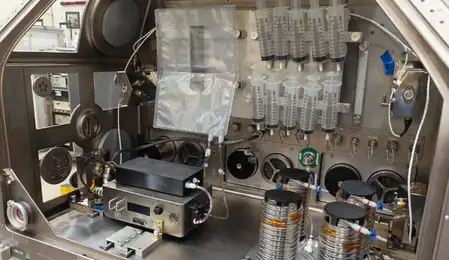
The system for this test, called IVGEN Mini, was delivered to the space station along with other instruments, experiments and hardware on April 11 via NASA’s Northrop Grumman Commercial Replenishment Services-24 (NG CRS-24) mission. This system will create IV fluids to prove that the design works properly under space conditions.
This system works by filling the space station’s drinking water into a large bag. The bag is attached to the IVGEN Mini. The system filters water thoroughly and completely removes particles and mineral ions. Then this purified water goes into a bag, which is already filled with sodium chloride in a predetermined amount. Mixing the two in the right proportion results in a sterile and medically safe IV fluid.
Courtney Shkurko, NASA Glenn’s engineering project manager, said the plan is to conduct temporary operations in May after launch. The crew present at the space station will run this system for two days and prepare about 10 liters of liquid. After this, this liquid will be brought back to Earth and examined. The investigation will show that the fluid made in space has met all the required standards and is completely safe for use.
IVGEN Mini is a second and improved version of this technology. The original IVGEN system was demonstrated on the space station in 2010. That system was quite large, as it contained many additional sensing instruments. After successful testing, the team worked to make it smaller, lighter and more efficient.
Giving an example, Shkurko said, “If 100 liters of IV fluid were to be carried to a mission to Mars, 100 1-liter bags would take up a lot of space. The IVGEN Mini takes up much less space. It is a better option between carrying bags in advance and the risk of expiration. Carrying a smaller device and making up the fluid as needed means the fluid will always be fresh and usable.”
The capacity of the system is determined based on what medical events can occur in deep space and how much fluid is required to treat them. The current model can prepare 1.2 liters of IV fluids per hour.
–IANS
MT/VC