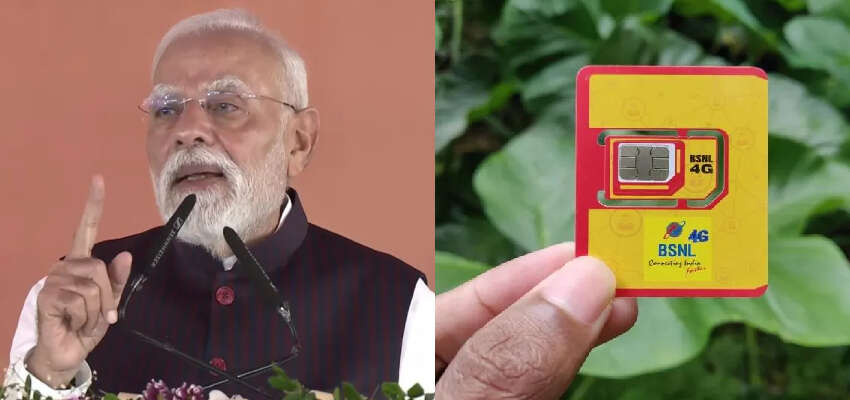
India has achieved a major achievement in the telecom sector. Prime Minister Narendra Modi simultaneously launched the 4G service of BSNL across the country. The government telecom company has activated the network at 98,000 centers, making high-speed connectivity available in every state. With the move, BSNL has achieved 4G coverage across India, equal to private operators.
Network strengthened from 98,000 mobile towers
The announcement was made from Jharsuguda in Odisha, where Prime Minister Modi also inaugurated several other projects. BSNL successfully set up 98,000 4G/5G mobile towers on its 25th anniversary on 26 September. Union Communications Minister Jyotiraditya Scindia announced that 1,00,000 more towers would be set up in the future, which would further improve the network.
4G network based on fully indigenous technology
Unlike private companies, BSNL’s 4G network is completely based on indigenous technology. The hardware and software used in this service have been developed in India only. With this achievement, India has joined the selected five countries (including Sweden, Denmark, China and South Korea) that has its own self -sufficient telecom infrastructure. The government has invested around ₹ 37,000 crore in this project.
Benefits and affordable plans for users
More than 9 crore customers will directly benefit from BSNL 4G. The company’s recharge plans are 30 to 40 percent cheaper than private operators. Earlier, many users used to turn to private companies due to network problems, but now BSNL will try to win their trust with fast speed and better coverage. This can also increase the trend of mobile number portability.
Roadmap for 5G and 6G
BSNL is preparing to start 5G services soon. It is expected that by the end of this year, 5G will be available in metros like Delhi and Mumbai. Prime Minister Modi also said that India is moving towards starting 6G services by 2030, making it one of the first countries to receive 6G service.
Important role of TCS and Tejas Network
BSNL’s indigenous network became possible through partnership between Tata Consultancy Services (TCS) and Tejas Network. TCS handled the network integration, while Tejas Networks developed radio access systems. This collaboration has helped BSNL to provide a completely self -sufficient 4G solution to the vision of self -sufficient India.