
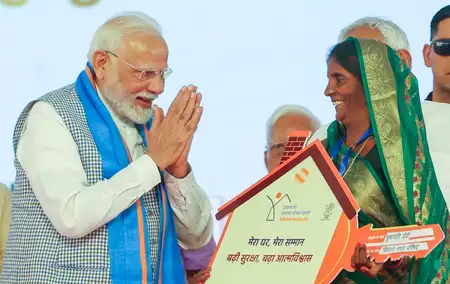
New Delhi, October 15 (IANS). At least 1.2 crore houses have been sanctioned under the Pradhan Mantri Awas Yojana-Urban (PMAY-U) and PMAY-U 2.0 till August 25. According to an SBI report on Wednesday, the scheme is acting as a transformative agent, becoming a catalyst in increasing discretionary and non-discretionary spending with visible impact on wealth, financial stability and well-being.
According to the report, the construction work of 75 percent of all the sanctioned houses has been completed.
Dr Soumya Kanti Ghosh, Group Chief Economic Advisor, State Bank of India (SBI), said, “While most states have a progress rate of 75 per cent or more, there are some states where the progress is less than 60 per cent, which include Andhra Pradesh, Bihar and Haryana.”
PMAY-U 2.0 was launched on September 1, 2024 to provide central assistance to 1 crore eligible urban households, to ensure that citizens of urban India enjoy a better standard of living.
Eligible families belonging to EWS, LIG and MIG categories, who live in urban areas and do not have a permanent house anywhere in the country, can purchase or construct a house under PMAY-U 2.0.
The Normalized Shannon Entropy Score is 0.84, indicating spatial uniformity in housing construction under PMAY. This shows that housing benefits are widely distributed across states, with even low-income states actively participating in the entire process.
According to the report, the impact on household spending is positive for both non-discretionary/debit card and discretionary spending/UPI transactions.
The report further said, “The increase in debit card spending for the least affluent households indicates that access to subsidized housing loans provides them with greater financial freedom and flexibility. Although a portion of the loans are spent on construction activities, these households experience a predictable wealth effect.”
In terms of expenditure, the 25 percent least expensive households meet their expenses from traditional sources like debit cards.
The impact of discretionary household spending after disbursement of Pradhan Mantri Awas Yojana installments is more pronounced on women borrowers, the report said. UPI spending has witnessed growth across all age groups and urban and semi-urban areas.
–IANS
SKT/