
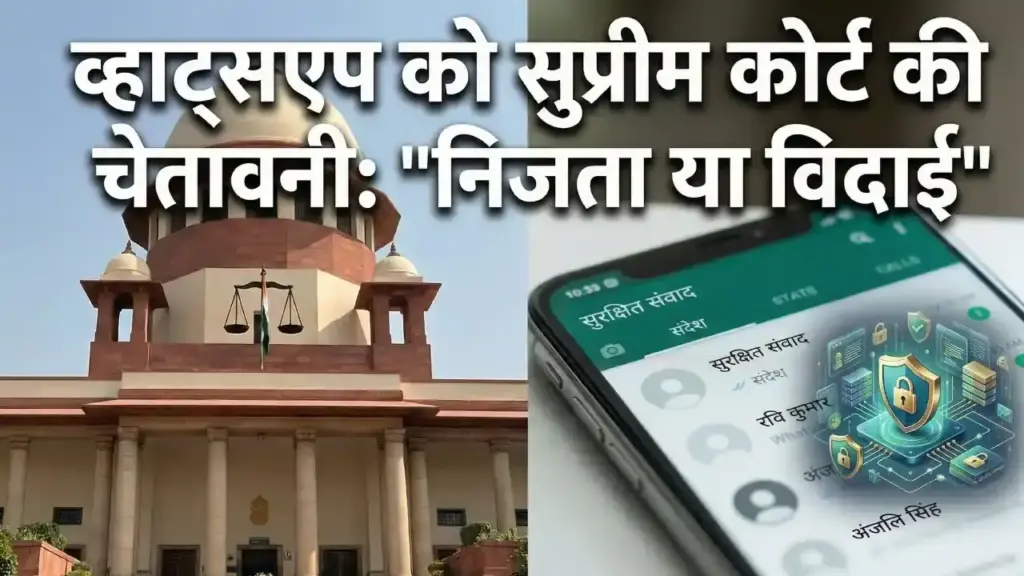
In India, WhatsApp is not just a messaging app but has become an essential part of everyday life. Be it family conversations, office work, payments, or business chats, WhatsApp is everywhere. The Supreme Court of India issued a stern warning to WhatsApp’s parent company, Meta, and the case made headlines. Comments like “If you can’t follow our Constitution, then leave India” clearly show that the court was in no mood to make any concessions to user privacy.
How the WhatsApp privacy controversy started
The root of this entire controversy lies in the new privacy policy of WhatsApp, which was released in 2021. In this update, users were told that WhatsApp can share some user data with other companies of Meta Group. It was said in the policy that this data will be used for the purpose of improving service, customization and marketing. The biggest problem was that users had only two options: either accept the new terms or delete their WhatsApp account. People got angry due to lack of option to opt out of data sharing.
Why were concerns raised despite end-to-end encryption?
WhatsApp clarified that private chats between friends and family remain end-to-end encrypted. However, data about interactions with business accounts may be collected and used for advertising. In a country like India, where millions of people depend on WhatsApp, this did not bring much relief.
Why did this issue become heated again in 2026?
The matter reached the Supreme Court after WhatsApp and Meta challenged the Competition Commission of India (CCI) order imposing a fine of ₹213.14 crore. CCI believed that the new privacy policy harmed both user choice and competition. During the hearing, the Chief Justice’s bench took a strong stance. The court questioned how consent can be considered genuine when users have the option to “take it or leave it”. This was called a fabricated consent, in which users are pressured to agree.
Strong comments from the Supreme Court
During the hearing, the court said that due to the strong hold of WhatsApp, people actually have no other option as almost everyone uses this app. The court clearly said that the right to privacy cannot be compromised at any cost, and the interests of business cannot be above the Constitution.
What is the stance of WhatsApp and Meta?
WhatsApp declined to comment publicly on the matter, but Meta’s lawyers argued in court that the service is free and users are not charged any fees. He said that not all data is shared and the company does not have access to private messages. However, the court did not seem to agree with these arguments.
Meta got ultimatum till 9th February
The biggest turning point in this case came when the Supreme Court asked Meta and WhatsApp to file an affidavit. The court wants the companies to clearly assure that user data will not be shared. February 9 has been fixed for issuing interim orders on this matter. If this assurance is not given, WhatsApp’s appeal may be rejected.
Can WhatsApp really leave India?
Although the language of the court was quite strict, at this time it seems difficult for WhatsApp to leave India. India is its biggest market, and a retreat would be a major blow to the company. The purpose of the court is not to throw out WhatsApp, but to send a message that it is necessary to respect constitutional values to work in India.