
New Delhi, June 12 (IANS). The Mumbai-Ahmedabad High-Speed Rail (MAHSR) project represents a significant change in India’s railway development, according to an official factsheet released on Friday. It is the country’s first high-speed rail corridor that is setting new standards in speed, connectivity and infrastructure delivery.
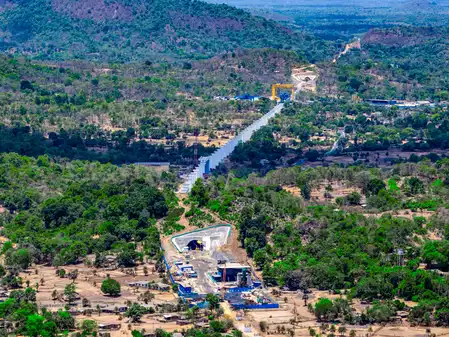
Significant progress in civil construction work, bridge construction and tunnel construction indicates continued momentum towards completion of the project. The scale of construction undertaken so far reflects the steady progress being made across the various components of the project.
At the same time, the adoption of advanced technology and engineering systems is strengthening domestic capabilities in high-speed rail development. The first high-speed rail service on the corridor is expected to begin in August 2027.
The MAHSR project will reduce the travel time between Mumbai and Ahmedabad to less than two hours. Currently the same journey by road takes 8-9 hours and by air about 4-5 hours including airport procedures. Faster travel will improve business efficiency and save valuable time for passengers.
At present, the maximum design speed in the Indian Railways network is approximately 180 kmph. In contrast, the Mumbai-Ahmedabad High Speed Rail (MAHSR) project has a design speed of 350 kmph and an operational speed of 320 kmph.
It is one of the most extensive rail infrastructure projects undertaken in India, and will connect Mumbai and Ahmedabad in approximately 1 hour 58 minutes.
The MAHSR project is not only a transportation initiative but also acts as a catalyst for India’s long-term high speed rail ambitions.
Apart from providing high speed passenger transport, the project will also establish a domestic high speed rail ecosystem for the first time. This ecosystem includes viaduct construction, installation of ballastless track, tunnelling, bridge launching and station-area planning.
This includes signaling and power systems as well as specialized training for Indian engineers and technicians. The knowledge, skills and capabilities developed through this project will support future high-speed rail corridors across the country.
The 508 km long MAHSR corridor passes through Maharashtra, Gujarat, and Dadra and Nagar Haveli. This corridor has 12 stations at Mumbai (BKC), Thane, Virar, Boisar, Vapi, Bilimora, Surat, Bharuch, Vadodara, Anand, Ahmedabad, and Sabarmati. Each station has been designed to reflect the character and spirit of its host city. Contemporary architecture, modern amenities, and multimodal connectivity are integral parts of their design.
Sabarmati station is being developed as a multimodal hub connecting bullet train, metro, BRTS and railway networks. The surrounding area is also being planned according to transit-oriented development principles.
The project is being developed using Japanese Shinkansen technology and operational standards. This corridor includes advanced systems for traction, electrification, track infrastructure and operations.
–IANS
ms/