
New Delhi, February 16 (IANS). The first solar eclipse of the year 2026 is on 17 February. This is an annular solar eclipse, known as ‘Ring of Fire’.
According to the US space agency NASA, a solar eclipse occurs when the Moon, Sun and Earth come in a straight line, due to which the Moon blocks the Sun’s light to some parts of the Earth for some time. This phenomenon occurs twice a year during eclipse seasons, because the Moon’s orbit is slightly inclined to the Sun-Earth orbit.
In this eclipse, the Moon is not able to completely cover the Sun, because it is relatively far from the Earth. The result is that the central part of the Sun is covered, but a bright ring is visible around it, which looks like a ball of fire.
This view of the Ring of Fire on Tuesday will be visible mainly in the remote and snowy areas of Antarctica, the maximum duration of the annular phase will be about 2 minutes 20 seconds. This will not be visible in India.
There are not one or two but four types of solar eclipse, these include Total Solar Eclipse, Annular Solar Eclipse, Partial Solar Eclipse and Hybrid Solar Eclipse.
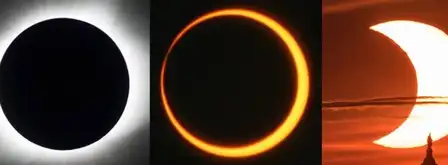
Total Solar Eclipse:- In this, the Moon completely covers the Sun and temporarily the Sun’s rays are unable to reach the Earth, due to which there is darkness even during the day and the Sun’s corona (outer atmosphere) is visible. This is the most rare and beautiful sight.
Annular Solar Eclipse: In this the Moon appears smaller than the Sun, hence a ring is formed. An annular solar eclipse occurs when the Moon passes between the Sun and Earth and the Moon appears smaller than the Sun, unable to completely cover the Sun. As a result, a bright ring of fire is formed around the Sun, which looks beautiful.
Partial Solar Eclipse: In this, only a part of the Sun is covered, as if a piece has been cut. During a partial solar eclipse, the Moon passes between the Sun and the Earth, but the three are not completely in a straight line. Due to this, only a part of the Sun is covered, the rest part remains shining, due to which the Sun appears in half or like the shape of the moon.
Hybrid Solar Eclipse: Due to the curvature of the Earth, it appears total at some places and annular at others. A hybrid solar eclipse occurs when the Moon completely covers the Sun in some places (total eclipse) and only forms a ring in other places (annular eclipse). This is due to the curvature of the Earth and the length of the Moon’s shadow.
–IANS
MT/AS