
New Delhi, January 10 (IANS). Scientists of Mohali-based Institute of Nano Science and Technology (INST) have made an important discovery. This institute works under the Department of Science and Technology (DST). Scientists have discovered semiconductor properties of a well-known self-assembling bacterial shell protein. With this, such electronic devices can be made in the future, which are safe, body friendly and do not harm the environment. Such devices can range from mobile phones, smart watches to medical devices and environmental monitoring sensors.
Traditional semiconductor materials like silicon are very useful today, but they also have some limitations. They are rigid, require a lot of energy to make, and add to electronic waste. For this reason, there is a growing need for electronics that are durable, soft and can easily adapt to the body, such as wearable devices, body implants and eco-friendly sensors.
In this research, scientists experimented on such bacterial proteins, which automatically assemble and form thin and flat layers. These layers naturally contain a special structure of electrons. Scientists wanted to know whether these proteins could be naturally photoactive.
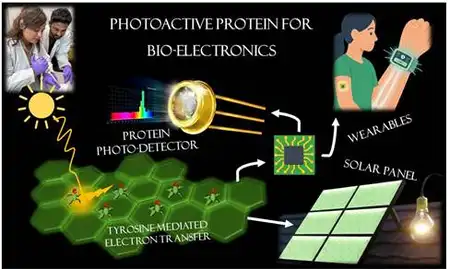
They found that when proteins form flat sheet-like films they absorb ultraviolet light and generate an electric current without any additional dye, metal, or external power. That is, they work exactly like the semiconductors used in electronic devices.
Scientists also observed that as soon as ultraviolet light falls on these proteins, very tiny electrical charges start moving on their surface. The team led by Dr. Sharmistha Sinha, along with student researchers Silky Bedi and S. “This happens because the protein contains tyrosine, which is a natural amino acid that can release electrons when excited by light. As these electrons and protons move, the protein sheet generates an electrical signal – just like a small solar cell works. This light-driven effect depends on the internal order of the protein and does not require any synthetic additives or high-temperature fabrication.”
“This discovery opens up exciting possibilities for the real world. Because this material is flexible and body-friendly, it can be used to create wearable health monitors, skin-safe UV-detection patches, and implantable medical sensors that work safely inside the human body,” the team said.
This research has been published in the journal Chemical Science of the Royal Society of Chemistry. In the future, families, patients and the general public may have access to devices that are soft, comfortable, eco-friendly, and easy to use in everyday life.
–IANS
AS/