
New Delhi, February 15 (IANS). Now the winter season is slowly bidding farewell and the summer season is ready to knock. In the coming days, heat wave, continuously rising temperature and rain from the sky will be seen troubling people again. But have you ever wondered what the sun is, due to which we feel uncomfortable?
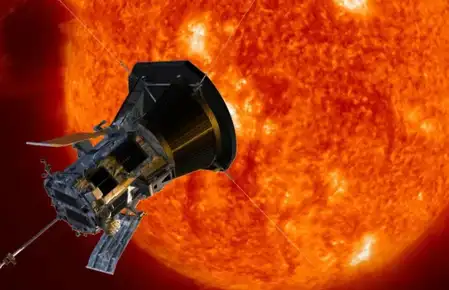
The Sun, about 4.5 billion years old, is a huge celestial body full of mysteries. Every aspect of its temperature, its structure and its energy remains a subject of study for scientists even today. The Sun is a ‘yellow dwarf’ star, an extremely hot and bright sphere composed mainly of hydrogen and helium gases. This is the center of our solar system, around which all the planets including the Earth revolve.
The average distance from the Earth to the Sun is about 93 million miles i.e. 150 million kilometers. It is the only star in our solar system and is also the basis of life on Earth. Without energy from the Sun, neither light nor life is possible.
According to the American space agency NASA, looking at the Sun it seems that it is stable, but it is a dynamic star that keeps changing and sending energy into space. The study of the sun and its effects on the solar system is called heliophysics. The Sun is the largest body in the Solar System, its diameter is about 865,000 miles i.e. 1.4 million kilometers, i.e. 109 times larger than the Earth. If the Sun were hollow, it could hold 1.3 million Earths. Its gravitational force keeps the planets, asteroids and comets in orbit.
Although the sun is very important for the Earth, it is an ordinary star in the universe. Stars 100 times larger than this have been found and many systems contain two or more stars and through its study scientists understand distant stars. The hottest part of the Sun is the core, where the temperature is more than 27 million Fahrenheit or 15 million degrees Celsius.
The surface visible from the Earth is called photosphere, whose temperature is 10,000 degrees Fahrenheit i.e. 5,500 degrees Celsius. The photosphere is the ‘light sphere’ from which most light originates. But the biggest mystery of the sun is the corona. The farther the corona moves from the surface, the hotter it becomes, with temperatures reaching 3.5 million degrees Fahrenheit or 2 million degrees Celsius. The mystery of ‘Corona Heating’ is still unsolved.
The radius of the Sun is 7 lakh kilometers, its nearest neighbor Proxima Centauri is 4.24 light years away. The sun is in the Orion Spur Arm of the Milky Way Galaxy. It takes 230 million years to complete its revolution around the center of the Galaxy at a speed of 4 lakh 50 thousand miles per hour. The Sun rotates around its axis in 25 days and at the poles in 36 days, according to the Earth’s day. Its spin is inclined by 7.25 degrees. The special thing is that the Sun is not solid, so different parts rotate at different speeds.
The Sun goes through a solar cycle every 11 years. The atmosphere of space is affected by solar activity. This affects satellite, GPS and power grid. NOAA Space Weather Prediction Center issues alert. The Sun is the basis of life on Earth, its light keeps the Earth warm and provides it with energy.
–IANS
MT/AS