
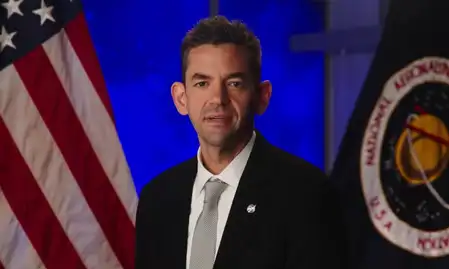
Washington, April 25 (IANS). US space agency NASA (National Aeronautics and Space Administration) has set three major goals of its new space strategy for the coming years, which include sending humans again to the Moon by 2028, building a permanent base there and expanding commercial activities in low-Earth orbit.
NASA Administrator Jared Isaacman said that this strategy is consistent with the US national space policy and is designed to strengthen America’s leadership in a rapidly changing global competitive environment.
Isaacman said clearly, “Our goal is to return to the Moon, increase the number of launches, and land American astronauts on the lunar surface by 2028.” He explained that this is the main focus of NASA’s near future missions.
He further said that the agency does not want to be limited to just reaching the Moon, but plans to establish human presence there for a long period. For this, government and private companies will work together. This plan will include essential things like lander, rover, power system and communication technology, so that continuous operation on the Moon can be possible.
The third important part of NASA’s strategy is to increase commercial activities in low-Earth orbit. Under this, private space stations will be promoted and new opportunities will be created for industries. “We want to work with industry to expand commercial astronaut missions and the revenue opportunities associated with them,” Isaacman said.
He also told that NASA is now changing the way it uses its resources. The agency is shifting from big and expensive projects to small, focused and result-yielding investments. He acknowledged that in the past several missions had faced problems like cost overruns and delays, due to which the need for improvement was felt.
“We cannot create programs that are too big to fail, but too expensive to succeed,” Isaacman said. He said that NASA needs to focus on results rather than expenses.
He also mentioned increasing the number of launches and said that longer intervals between missions slow down progress. Referring to the recent Artemis II mission, he said that when programs are implemented properly, big results emerge. In this mission, the astronauts were circled around the Moon and brought back safely.
“We showed the world the Moon again and gave humanity a new perspective on the Earth,” he said.
Under the new plan, NASA will rely more on private companies for tasks like satellite launch and Earth observation, while itself focusing on complex missions like deep space exploration and nuclear propulsion.
However, MPs have also expressed some concerns over this strategy. During the hearing, it was told that the proposed budget has been reduced by about 23 percent compared to last year, due to which it may be difficult to achieve these targets.
Space Committee Chairman Brian Babin warned that less funding could weaken America’s space competitiveness, especially at a time when China is rapidly advancing its lunar missions. “It doesn’t make sense to underfund NASA,” he said.
At the same time, ranking member Joe Lofgren said that this plan could affect many important programs of science and technology, especially those areas not related to human space missions.
Other lawmakers also raised questions about the impact on the workforce, Earth science missions and aeronautics research, as well as concerns about increased reliance on private companies.
To this Isaacman replied that NASA will always work according to the law and maintain transparency in the use of resources. He expressed confidence that better results can be achieved even with less resources, provided unnecessary expenditure is eliminated and focus is placed on the main goals.
Founded in 1958, NASA has long led the world in space exploration, whether it was landing on the Moon under the Apollo program or building the International Space Station. In recent years, particularly due to increasing competition with China, there has been a renewed emphasis on Moon missions and human presence beyond Earth.
The Artemis program is an important initiative in this direction, whose objective is to send humans back to the Moon for the first time since 1972.
–IANS
VKU/AS