
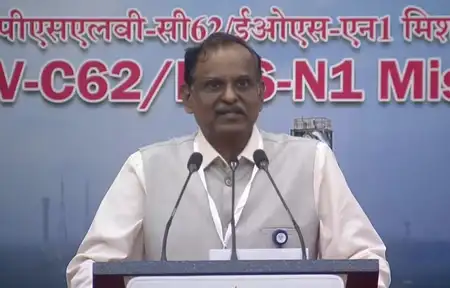
New Delhi, January 12 (IANS). A technical glitch has surfaced in the third stage of the PSLV-C62 mission rocket launched this morning. ISRO Chairman Dr. V. Narayanan said that investigation into this problem has been started.
The Polar Satellite Launch Vehicle (PSLV) rocket was to place the EOS-N1 Earth observation satellite and 15 other small satellites sent with it into a sun-synchronous orbit. The launch was carried out at 10.17 am from the First Launch Pad (FLP) of the Satish Dhawan Space Center in Sriharikota.
Speaking to the media after the launch, the ISRO chief said that a disturbance was observed in the path of the rocket at the end of the third stage, due to which the mission could not proceed.
He said that the rocket worked perfectly till the third stage, but after that there was a slight change in flight. He said that the team of scientists is studying the data received from all the ground stations.
ISRO chief said that PSLV is a four-stage rocket. Its first stage is of solid fuel, the second is of liquid fuel, the third is of solid fuel and the fourth is of liquid fuel. The rocket’s performance by the end of the third stage was as predicted.
He said that at the end of the third stage, movement was seen in the rocket and its path changed. For this reason the mission was not successful. Further information will be given only after complete investigation.
Earlier, the PSLV-C61 mission, launched in May 2025, also faced technical problems in the third stage. The objective of that mission was to place the EOS-09 satellite in a 505 km high orbit, but it could not be completed.
The PSLV-C62 mission was the first space launch of the year 2026 and was the 64th flight of PSLV.
The EOS-N1 satellite, also known as Anvesha, was intended to strengthen India’s ability to monitor agriculture, city planning and the environment.
Under this mission, the KID or Kestrel Initial Technology Demonstrator, developed by a Spanish startup, was also to be demonstrated, which is a prototype of a small re-entry vehicle.
This mission was the ninth commercial mission conducted by NewSpace India Limited, the commercial arm of ISRO.
This launch was the fifth mission to use the PSLV-DL variant, which featured two solid strap-on motors.
PSLV has completed 63 successful flights so far. Its major missions include Chandrayaan-1, Mars Orbiting Mission, Aditya-L1 and Astrosat. In the year 2017, PSLV created a world record by launching 104 satellites in a single mission.
–IANS
DBP/AS