
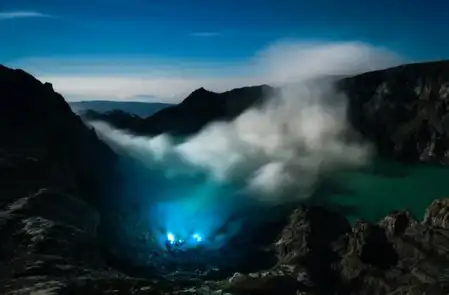
New Delhi, April 12 (IANS). Nature is as beautiful as it is mysterious. Seeing such mysterious places, people do not believe that such a place can exist. There is a similar lake in East Java, Indonesia, which has been recognized by UNESCO as a natural heritage of the Earth.
The place is rich in volcanic landscapes, unique geological formations and cultural heritage. The most striking feature here is Mount Ijen, a stratovolcano inside which is a picturesque turquoise crater lake called Kawah Ijen. According to UNESCO, it is the most acidic lake in the world.
Ijen Geopark has a high concentration of volcanic cones, craters and lava flows. Millions of years of complex geological processes have shaped the region. There are about 22 volcanic cones inside the Ijen caldera system. The area is also linked to the Belambangan Biosphere Reserve, designated by UNESCO in 2016. The view of Kawah Ijen Crater Lake is extremely beautiful. Its water is turquoise in colour.
According to the American space agency NASA, on August 22, 2013, the Landsat 8 satellite captured a picture of this lake. The pH of the lake is less than 0.3. In comparison, the pH of lemon juice is 2. Due to such acidity, this lake is said to be the largest and most acidic crater lake in the world. The acidity of this lake comes from volatiles released from the magma, chemical reactions with the rocks, evaporation, and underground hot water systems.
The Banyupahit River originating from the lake is also acidic, with a pH ranging between 2.5 to 3.5. This river affects the surrounding ecosystem.
The most mysterious attraction of Ijen is the sight of the blue fire. Sulfuric gases coming out of the crater’s cracks burn at temperatures exceeding 360 degrees Celsius. Blue flames are created by the reaction of sulfur and oxygen. Common volcanoes show red or orange fire, but Ijen produces blue fire due to the high sulfur concentration. This view gets hidden in sunlight, so it is clearly visible only at night.
The Ijen volcano is active and sulfur is also mined here. Workers cool the gas by installing pipes in the crater and extract sulfur. However, this work is dangerous due to poisonous gases.
–IANS
mt/pm