
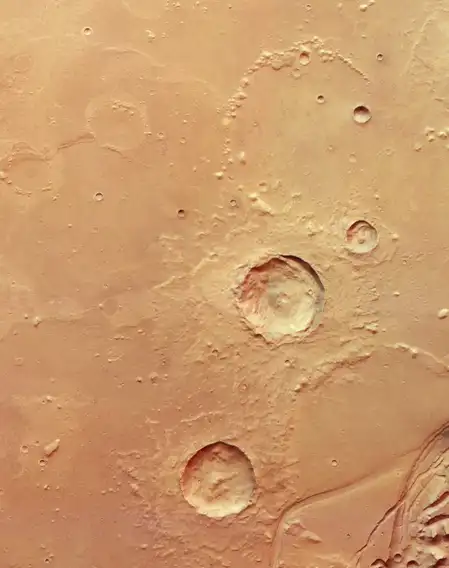
New Delhi, May 17 (IANS). Along with Earth, the world of other planets is also full of mystery and adventure. The European Space Agency (ESA) has shown the very old mystery of Mars more closely. Posting the pictures on its social media, the agency said that about 3.5 billion years ago, the water hidden under the surface of Mars suddenly burst onto the surface and caused a severe flood.
The water hidden beneath the ground suddenly burst onto the surface, creating a huge valley 10 kilometers wide and 500 meters deep. This flood was so powerful that it created a 1,300 kilometer long channel called Shalbatana Valley, which is almost the length of Italy.
New photos taken by ESA’s Mars Express spacecraft provide an exciting glimpse of this ancient event. The pictures surfaced show the surface of Mars, which was shaped by water, lava and time. It is clearly visible in the pictures that many pits were formed over time which are called impact craters. Along with the patches of volcanic ash carried by the winds, there are also ridges or disturbed areas formed by the cooling of the lava, where the rocks are broken and scattered. This region is located between the southern highlands and northern lowlands of Mars. Nearby is Chryse Planitia, which is considered to be the lowest region of Mars.
Scientists believe that there may have once been an ancient ocean here. Mars Express has been continuously orbiting Mars since 2003 and collecting information about it. NASA and Italian Space Agency are also involved in this mission.
Its most important instrument is the MARSIS radar, which detects water, ice and other geological formations beneath the surface of Mars. This discovery is very important in understanding the past of water on Mars.
Scientists say Mars may once have been warm and humid, where rivers, lakes and perhaps even oceans existed. Later with changing climate this water dried up or went underground.
–IANS
mt/pm