
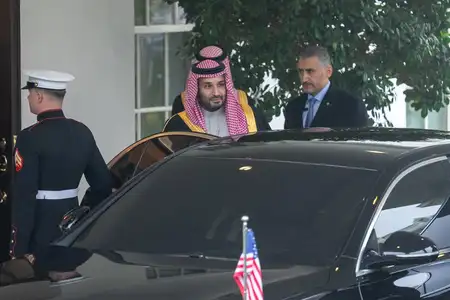
New Delhi, November 20 (IANS). There was a gathering of stalwarts at the royal dinner at the White House. US President Donald Trump organized it in honor of Saudi Crown Prince Mohammed bin Salman. The discussion included personalities like Tesla owner Elon Musk, Blackstone’s Steve Schwarzman, footballer Ronaldo, Nvidia CEO billionaire Jensen Huang, and AMD CEO Lisa Su.
This in itself gives a very important indication that influential investors associated with Trump, tech sector giants and Arab powers like Saudi were once again seen standing on a common platform. This is not just a business equation, but a sign of a new era in which American power, global capital and emerging technology empires are reuniting to strengthen each other’s interests.
The day after the dinner, i.e. on Wednesday, a very important meeting took place between the two countries, in which it became clear that Donald Trump is relying more on the development of tech sector and artificial intelligence to fulfill his economic agenda.
The crown prince has pledged to invest $1 trillion in US companies, a promise mostly about using Saudi Arabia’s oil and natural gas reserves to turn his country into an AI data hub.
“We will work together with our friends and partners in this room to build the largest, most powerful, most innovative AI ecosystem in the world,” Trump said at the US-Saudi Investment Forum on Wednesday.
Sitting in the front row of the audience at the Kennedy Center were Nvidia co-founder Jensen Huang and tech billionaire Elon Musk.
A statement came later. Elon Musk’s XAI and Jensen Huang’s Nvidia announced they are partnering with Saudi Arabia’s state artificial intelligence firm to build a massive AI data center.
According to reports, the center is expected to consume up to 500 megawatts of power—making it XAI’s largest site outside the US.
Under the deal, Musk’s XAI chatbot, Grok, will be deployed across Saudi Arabia, according to a press release from XAI.
In May this year, the Crown Prince launched a new artificial intelligence company, Human, which aims to develop large-scale Arabic language models and establish the kingdom as a global hub for AI innovation and leadership.
The creation of HUMAN is in line with the broader goals of the Kingdom’s economic transformation plan, Vision 2030, and underlines its ambition to become a leader in high-tech sectors.
Now let’s come to that new blossoming relationship towards which the world is gazing. This relationship shows that the “trade + tech + diplomacy” alliance in the US is getting stronger again. This means that the foreign policy of the White House, the technological ambitions of Silicon Valley, and the immense capital of the Middle East—all three seem to be converging on a common strategic axis. For the Saudi leadership, this relationship is not only a part of economic diversification but also a means of direct access to America’s political power centers.
On the other hand, for Trump, Arab cooperation signals that his influence on global capital is still deep, and if he returns to power, this network will give him additional leverage on issues such as China, energy markets and tech security. The presence of a personality like Elon Musk in this siege gives technical legitimacy and futuristic prestige to this alliance. Saudi investments in areas like AI, space research and digital infrastructure get a credible US tech platform.
The effect of such a triangular alliance will be that the influence of capital and tech in global policies will increase much more. Traditional diplomacy will be replaced by new elements like deals, investments, defence-technology and digital control. This alliance between America and Saudi can also play an important role in the balance of power against China.
In short, this coming together is not just a photo-op; This is a sign that a new triangular era of tech billionaires, energy moguls and political powers is taking shape in global politics in the coming years.
Trump gave a warm welcome to MBS in the Oval Office, calling him a “very good friend”. Saudi Arabia announced to increase investment in America by about 1 trillion dollars (about Rs 84 lakh crore). Earlier there was a promise of $600 billion, which will now expand into AI, energy and infrastructure. There is a plan to spend 50 billion dollars on chips (semiconductors).
Agreements were also reached on cooperation in the energy sector and defense sector. The US also gave Saudi the status of Major Non-NATO Ally, which is very significant.
–IANS
kr/