
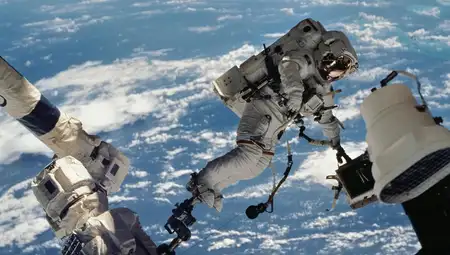
New Delhi, March 4 (IANS). For the last 50 years, the Human Research Program of the American space agency NASA has been trying to understand what changes the human body undergoes in space. The results obtained in a research are used to keep astronauts safe, improve spacecraft and spacesuits, prepare fitness programs, nutrition and mental health training. As missions move from low-Earth orbit to the Moon and Mars, it has become even more important to understand the effects of long periods of time in space.
Under NASA’s Artemis program, preparations are underway to land astronauts on the moon. For this, the aim is to collect more data while keeping the astronauts healthy. The focus is on how the body reacts, especially to long missions. Astronauts like Scott Kelly and Christina Koch spent about a year aboard the International Space Station, twice the previous average.
A study provided valuable data on physiological and psychological changes in space, which will be useful for decades to come. NASA has named the main threats to the body in space as ‘RIDGE’. This is the short form of the Big Five risks, which are Space Radiation, Isolation and Confinement, Distance from Earth, Gravity Fields, and Hostile or Closed Environment.
The biggest and most worrying danger among these is space radiation. NASA said that the magnetic field and atmosphere on Earth protects from most harmful particles, but astronauts in space face radiation from three main sources: particles trapped in the Earth’s magnetic field, solar energetic particles coming from the Sun and galactic cosmic rays. Galactic cosmic rage is especially difficult to avoid.
Long-term exposure to radiation increases the risk of degenerative diseases like cancer, heart diseases, cataracts etc. Animal and cell studies have shown that space radiation is more dangerous than Earth’s radiation. Moon and Mars missions will be much longer than six-month space station missions, so the total radiation dose will increase and the health risks will also be greater.
In such a situation, NASA is making new detectors for radiation monitoring, so that the quantity and type of radiation can be better estimated. Also, efforts are underway to reduce the risk through shielding, real-time monitoring and special operational procedures. The risks are not the same for missions that last six months or years in space. By understanding this difference, NASA is making better preparations for future deep space missions.
–IANS
MT/DSC