
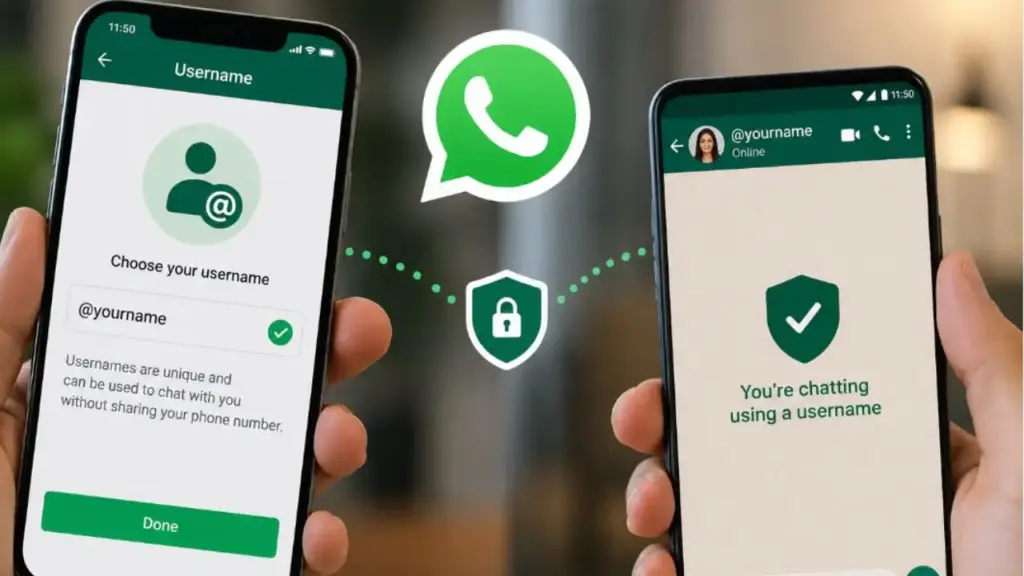
WhatsApp, the popular messaging app with more than 300 crore (3 billion) users, has introduced ‘username’ feature as an alternative to mobile number. This means users no longer need to share their phone number to chat with others; Only the username will be sufficient. Many people, including the global head of WhatsApp, consider this a revolutionary step towards increasing privacy; However, in a large and digitally active country like India, debate has also started on the security concerns related to this feature. Some experts believe that this step could become a new means of cyber crime. Let us understand what security concerns are being raised regarding this new feature and why experts are worried.
**Is this a big challenge for law enforcement agencies?**
Senior IPS officer Arun Bothra has highlighted the concerns of law enforcement agencies regarding this feature. He says that the username-based identification feature of WhatsApp can become a big challenge for the police and investigating agencies.
Giving the example of Telegram, he said that similar features have made Telegram a big headache for investigating investment scams, fake currency cases and cyber crimes. According to Arun Bothra, “WhatsApp is much bigger in scope than Telegram. When it comes to millions of users, even a small change in the app’s design can have a big and serious impact on people’s security.”
**Will scams like ‘Digital Arrest’ reduce?**
There is another aspect to this debate. Vimal Lakhotia (@vimallakhotia) believes that this feature can be helpful in some cases. He raised the question: Will this not reduce dangerous scams like ‘digital arrest’? This feature will keep users’ mobile numbers hidden, so it will be more difficult for scammers to track targets or hack them using their phone numbers. In other words, since the phone number remains hidden, the average user will have a degree of protection.
**Danger of impersonation: Risk of scams**
Entrepreneur and influencer Ankur Wariku has raised serious concerns over the practical risks associated with this feature. He argues that in a country like India, where digital literacy is not yet fully developed, this feature could prove to be a major ‘disaster’ unless WhatsApp implements a strong system to prevent its misuse. Wariku explained this with an example: “Let’s say you get a message from a username that looks like me – like *Wariku*, *Awariku*, *AnkurWariku*, *Ankur_Wariku*, or *AnkurWarikuOfficial* – asking for money. Any normal person can easily get duped.”
He gave two main reasons for this:
Most people in the country do not understand the intricacies of ‘verified status’ or ‘blue tick’. Since the concept of username is related to privacy, you cannot just make a phone call and find out whether the person on the other end is real or an impersonator. Narrating his own experience, Wariku said he had fought a legal battle against Meta because AI-generated ads featuring his face were being used on Facebook and Instagram to lure people into fake WhatsApp investment groups. According to him, it is very easy to run such scams in India.
**How effective is the ‘username key’?**
Addressing this concern, Pritish Joshi suggested a solution: the option of ‘username key’ setting in WhatsApp. It will have a 4-digit code, and only the person who knows that code will be able to contact or chat with you. However, Ankur Wariku says that this feature solves only one specific problem – preventing strangers from reaching out to you directly. But, this doesn’t solve the problem where ‘scammers want you to contact them.’ The process of cheating people through fake profiles may continue.
When there is no such investigation on X, Facebook and Telegram, then why is there a problem with WhatsApp?
While social media user Arunima Ganguly defended this feature, saying that the same method has been adopted on X (Twitter), Facebook and Telegram for years and there was no uproar, Ankur Wariku made the most important argument in the Indian context. He said it is a matter of ‘scale’ (large-scale use). Currently, about 85 crore Indians use WhatsApp – many times more than the number of users of X or Telegram.
He said, “In India, WhatsApp is not just an app; it has become an integral part of everyone’s life, from common man to celebrities. When a feature like anonymization is introduced for such a large user base, the risk of scams increases manifold.” According to experts, a delicate balance will have to be struck between privacy and security: while introducing a username will keep the phone numbers of women and ordinary users safe, on the other hand it may also provide a new means for cyber criminals to commit fraud by hiding their identity. The company has not yet provided information on how it will strengthen its anti-abuse programs and systems through this feature.