
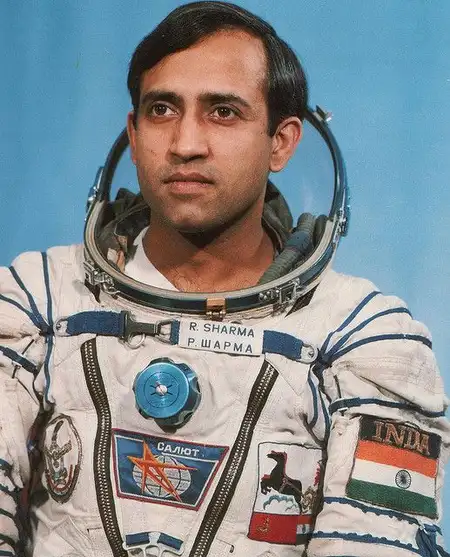
New Delhi, January 12 (IANS). ‘How does India look to you from above?’ When this question of the then Prime Minister Indira Gandhi reached the Soviet space station ‘Salyut-7’, there was silence for a moment. Then a quiet but confident voice echoed, ‘Saare Jahan Se Accha.’
That evening of 3 April 1984 was not just the success of a mission, but a roar of pride for 70 crore Indians. When Wing Commander (then Squadron Leader) Rakesh Sharma crossed the threshold of space through Soyuz T-11, he became not just a pilot but the messenger of millions of dreams.
Born on January 13, 1949 in Patiala, Punjab, the sky has never been a stranger to Rakesh Sharma. The dreams he dreamed of while growing up in the streets of Hyderabad got wings with his admission into the National Defense Academy (NDA) in 1966. His real test came in the 1971 war, where as a young pilot he flew 21 dangerous missions flying the MiG-21. It was these steely intentions that later made him the most suitable candidate for space travel among the 150 ace pilots.
Becoming an astronaut was not only an exciting experience but also a self-defeating process. When he was selected in 1982, he was sent to ‘Star City’ near Moscow. The training there was no less than an ordeal.
He had to learn Russian in just two months, because all the spacecraft’s manuals were in Russian. In Bangalore, they were kept alone in a closed room for 72 hours to test whether they could withstand the loneliness of space. In the ‘centrifuge’ machines, so much gravity pressure was exerted on their bodies that even breathing became difficult. But Rakesh Sharma was adamant. Wing Commander Ravish Malhotra was also with him as backup, who remained with him like a shadow till the last moment.
When the Soyuz-U rocket took off from the Baikonur Cosmodrome on April 3, 1984, India became the 14th country in the world to send a human into space. Rakesh Sharma spent 7 days, 21 hours and 40 minutes in space.
Rakesh Sharma’s mission was also strategically important. Under the remote sensing experiment named ‘Terra’, he took such pictures of India from space, which helped in changing the map of the country. From the hidden water resources of the Himalayas to the density of forests, the photographs he took took years of aerial survey of India in a few hours.
Today when India is preparing for its indigenous ‘Gaganyaan’ mission, 77-year-old Rakesh Sharma is its biggest guide. Recently, when Group Captain Shubhanshu Shukla was selected for the Axiom-4 mission, Rakesh Sharma said with a smile that it was like ‘deja-vu’ for him.
–IANS
VKU/ABM