
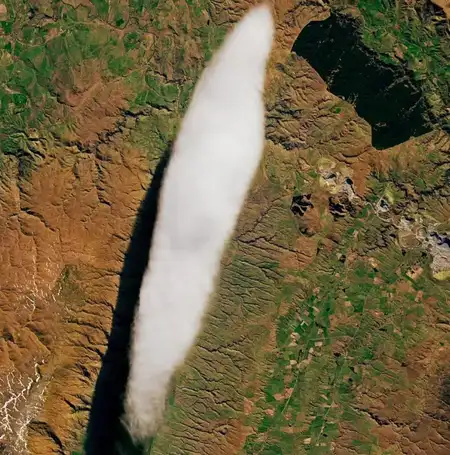
New Delhi, May 19 (IANS). Lens or saucer shaped clouds are often seen in the sky, which look very unique and attractive. These are called lenticular clouds. In technical language these are called altocumulus standing lenticulars.
Due to the smooth and clean edges of lenticular clouds, many people consider them to be UFOs i.e. unidentified flying objects. Lenticular clouds are also described as ‘floating plates in the sky’. These clouds form mainly over rugged mountainous areas, where strong winds are blowing. They are quite common in areas such as the Rocky Mountain Range, while relatively rare in some places such as Hawaii.
According to scientists, when strong winds hit a large geographical obstruction, such as a mountain range, the air has to pass over the mountains. In this process the air rises, expands and cools. If there is enough moisture in the air, then upon cooling the water vapor condenses and takes the form of clouds. When the air reaches higher, a cloud is formed. After this, the air descends, heats up and the moisture evaporates, thereby clearing the lower part of the cloud. For this reason the cloud appears lens shaped.
The special thing is that the air keeps passing through these clouds rapidly, but the cloud appears stable at one place. This is why they are also called standing lenticular clouds. A characteristic lenticular cloud forms regularly over the Otago region of New Zealand’s South Island, which locals call the Taieri Pet.
On September 7, 2024, its spectacular picture was captured by the Landsat 8 satellite of the American space agency NASA. This cloud forms over a hilly area called the Rock and Pillar Range near Middlemarch. Strong winds coming from the north-west direction hit this flat but steeply sloping hill.
According to American meteorologist John Law, the wind forms waves and a cloud forms on the crest of the wave and remains almost in one place. Strong winds give it its characteristic long lens-like shape. These clouds are important signals for pilots. There is a danger of strong wind and snow accumulation around them. Sometimes they also indicate upcoming rain. These not only present a beautiful view, but also help in understanding the activities of the atmosphere.
–IANS
MT/AS