
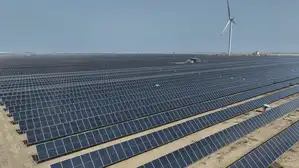
New Delhi, March 24 (IANS). India is converting the vast salt plains of the Rann of Kutch into the world’s largest renewable energy project, a major step towards the country’s clean energy and energy security.
The 30 gigawatt (GW) Khavda Renewable Energy Park, also known as Gujarat Hybrid Renewable Energy Park, is a mega solar and wind project spread over an area of approximately 72,000 hectares in Gujarat. Upon completion, it will be able to provide electricity to about 1.8 crore homes.
The project is notable for its scale, comprising approximately 20 GW of solar and 10 GW of wind energy. The objective of this hybrid model is to ensure continuous power supply by generating electricity from solar during the day and wind at night.
This project is being jointly developed by several government and private companies, including Adani Green Energy, NTPC, Gujarat State Electricity Corporation Limited and Gujarat Industrial Power Company Limited. Adani Green has the highest stake in this, about 9.5 GW.
Solar Energy Corporation of India has been given a major share in this project for wind energy.
This project was started by Prime Minister Narendra Modi in 2020. More than 1 GW of capacity has been commissioned so far, and will be completed in a phased manner in the coming years.
This project is an important part of India’s goal of achieving 500 GW non-fossil fuel capacity by 2030. Through this, barren land is being converted into a big energy center, which will increase employment and reduce dependence on coal.
However, the project faces some challenges, such as difficult working conditions, irregularity of renewable energy due to lack of energy storage and concerns about the impact on the desert environment.
Despite these challenges, the Khavra project is a major step forward in India’s clean energy transition, showing that underutilized land can be used for large-scale sustainable energy production.
–IANS
DBP