
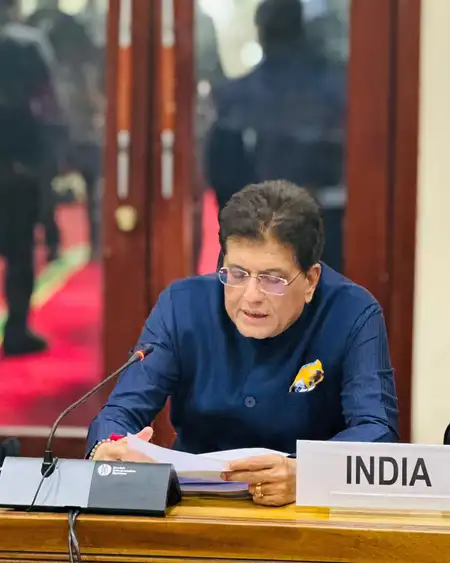
New Delhi, March 27 (IANS). Union Commerce and Industry Minister Piyush Goyal on Friday said at the ongoing 14th Ministerial Conference (MC14) in Yaoundé, Cameroon that WTO reforms should be taken forward through a transparent, inclusive and member-driven process with growth at its core.
He also stressed the need to maintain key principles such as non-discriminatory, consensus-based decision making and equality.
During the conference, Goyal met Cameroonian Prime Minister Joseph Dion Ngueta and discussed bilateral and multilateral issues including ways to strengthen India-Cameroon cooperation.
The leaders also discussed fundamental issues of the World Trade Organization (WTO), including its core principles.
Goyal met WTO Director General Ngozi Okonjo-Iweala to discuss the MC14 agenda and separately met his counterparts from the Netherlands, France and Ethiopia to review bilateral trade relations.
Additionally at the conference, Commerce Secretary Rajesh Aggarwal held bilateral meetings with counterparts from Chile, Paraguay, US, Nepal, Philippines, Saudi Arabia, Mexico, Peru, Russia and New Zealand as well as a delegation of EU Parliamentarians.
The WTO’s MC14 session began on 26 March in Yaounde with a formal session chaired by the Trade Minister of Cameroon and will end on 29 March.
The inaugural session was attended by WTO Director-General Ngozi Okonjo-Iweala and trade ministers and senior representatives of member countries.
The session was followed by a short programme, in which happiness was expressed over the implementation of the Fisheries Subsidy Agreement.
During this discussion the focus was on MC14 agenda and opportunities to strengthen bilateral trade relations. The talks with Chile and Peru also discussed the ongoing Free Trade Agreement (ATA) negotiations, while the talks with the EU and New Zealand reviewed the progress of their respective FTA negotiations.
India also reiterated that non-discrimination remains a fundamental principle of the WTO framework, as reflected in the Marrakesh Agreement.
The country also stressed the need for a development-focused agenda, including a permanent solution on Public Stockholding (PSH) for food security, effective special and differential treatment (S&DT) provisions for developing and least developed countries (LDCs) and the restoration of a fully functioning dispute settlement mechanism.
–IANS
abs/