
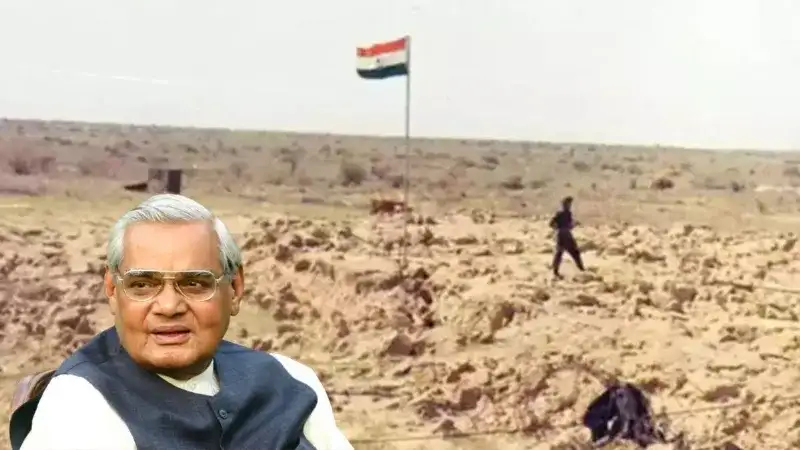
On May 11, 1998, at exactly 3:45 PM, history was being made beneath the scorching sands of Pokhran, Rajasthan. At that moment, India was not just conducting a test, but writing a new chapter in its strategic self-reliance. Under the leadership of Prime Minister Atal Bihari Vajpayee, India took a bold step that had been contemplated for years but lacked the courage to take a decision. Without any foreign help, and despite international pressure and especially close monitoring by the United States, India successfully conducted nuclear tests. It was not easy. Countries considered ‘nuclear powers’ always kept a close eye on countries that did not possess nuclear weapons. India was one of those countries which were continuously being prevented from acquiring this power. But Atal Bihari Vajpayee’s decision was not only the need of the hour, but also a strategy for the future.
Atal Bihari Vajpayee, born on December 25, 1924 in Gwalior, Madhya Pradesh, was a personality who created a distinct identity for himself even after mixing in the ocean of Indian politics. Atal Bihari Vajpayee achieved this prestige through strong political dedication and determination. His words were sharp and insightful, but his decisions were even more difficult. The 1998 nuclear test was one such difficult decision, which faced immediate criticism and pressure, but in the future it made India a more secure, powerful and self-confident nation. It was not just a blast, but a declaration of India’s self-respect and strategic sovereignty.
Coalition government of 13 parties
The test pit had already been dug. The tunnel was ready. The date of the test was also fixed. But the test was canceled at the last moment due to foreign pressure. But Atal Bihari Vajpayee dreamed of a strong India, and when he got the opportunity, he made it come true through his decisions. During his 13-day tenure as Prime Minister, he realized that there was not much time to conduct such an important test properly. When he returned to power on March 18, 1998, he gave the green signal to the scientists. In 1998, Atal Bihari Vajpayee’s government was a coalition of 13 parties. A few days after the swearing-in ceremony, former Prime Minister Narasimha Rao met Prime Minister Atal Bihari Vajpayee and said, “The stuff is ready, you can proceed.” About two weeks after showing his strength in Parliament, Atal Bihari Vajpayee called Dr. APJ Abdul Kalam and Dr. Chidambaram and instructed them to prepare for nuclear tests. It was APJ Abdul Kalam who suggested that the tests be conducted on Buddha Purnima, which was on May 11, 1998.
Vajpayee’s role in making India a nuclear power nation
In an interview, APJ Abdul Kalam said, “There was a lot of pressure. But he (Atal Bihari Vajpayee) decided that India would test with the DRDO team and, more importantly, with the atomic energy team. These were two teams. I and Dr. Chidambaram were there. We met him, and he asked to go ahead with the nuclear tests. Atal Bihari Vajpayee’s role in making India a nuclear-armed nation was decisive.”
At that time, Rajesh Mishra, Principal Secretary to the Prime Minister, was tasked with coordinating with the scientists. After getting the green signal from Atal Bihari Vajpayee, the work started with great caution. Construction work was usually done at night to avoid American satellites. The codename of this project was Operation Shakti. The scientists working on the operation never traveled together. They wore military uniforms and had codenames.
India’s clear message to the world
APJ Abdul Kalam’s codename was ‘Major General Prithviraj’, while Dr. Chidambaram’s codename was ‘Nataraj’. The 58th Engineers Regiment of the Indian Army provided full support in completing the ground work. At last, the decisive moment arrived. At 3:45 pm, the first bomb was detonated. This test gave India the long-needed nuclear deterrent. The world got a clear message that India is no longer dependent on anyone for its security and is capable of responding effectively to any attack.