
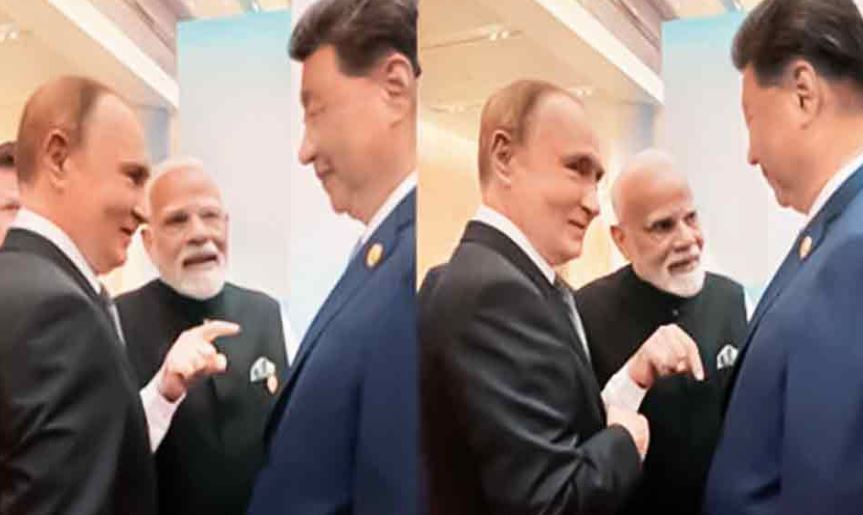
India’s compulsion to extend its hand towards China and Russia is increasing the irritation of US President Trump, but perhaps it is necessary for both of them to think in a new way for the sake of strategic interests.
The most talked about summit of the Shanghai Cooperation Organization (SCO) so far took place in Tianjin, China. There were different reactions to it in America and India. In America it was rejected as a summit of dictators, which yielded no concrete results. US President Donald Trump wrote in a social media post, “It seems that we have lost India and Russia to the darkest, darkest China.” May they have a long and prosperous future.” But the reality lies somewhere between these two reactions.
After three and a half decades of growing US-India partnership, India has returned to its original form of multilateral international relations. A multi-polar world system is ideal for India because it can play an important role in it.
Due to the political and economic upheaval in the world due to the anarchic stance of the temperamental US President Trump, the discussions about new changes in India-China relations and the ‘Russia-India-China’ triumvirate have intensified. Relations between America’s Western and Asian allies are deep, but the countries of the former non-aligned camp have maintained relations with Russia and China. In the summer of 2023, India’s Foreign Minister S. Jaishankar had said in an interview with The Economist, “This is not a matter of transaction but a geopolitical matter between the three big Eurasian powers, Russia, China and India.”
Diplomatic, economic and security relations between India and China have been tense since the 2020 clashes in the Galwan Valley in eastern Ladakh. The last high-level summit between Prime Minister Narendra Modi and President Xi Jinping was held in 2018. Both had avoided meeting during any multilateral conference. Xi did not come to the 2023 G20 summit held in India.
Secondly, it is not hidden from the eyes of Washington that India’s relations with China improved after Trump took office for the second time. Five years later, flights between the two countries resumed, visas started being granted and China announced the reopening of the Kailash Mansarovar Yatra route to the Hindu religious pilgrimage site.
Moreover, after avoiding bilateral meetings for many years, Modi met Xi at the SCO summit and bilateral talks took place. From the Indian side, Modi’s meetings with Xi and Russian President Vladimir Putin were highly publicized. In bilateral meetings, the two countries described each other as “partners for development, not rivals” and stressed the need for “mutual respect, mutual interest and mutual sensitivity”.
For many years, India has been considered part of the US campaign to isolate China in the world. But due to Trump’s economic pressure, India’s relations with China have softened. China is one of India’s top trading partners, but India has a huge trade deficit with China. In fact, India wants to increase its industrial infrastructure, hence it is dependent on the world’s factory i.e. China for everything from raw materials to spare parts and industrial equipment.
After the Galwan Valley incident, India strictly monitored Chinese investments and banned many Chinese apps including TikTok. China also recalled Chinese engineers working in Apple’s factories in India and banned the export of any industrial equipment and other industrial products to India. After five years of sanctions, China agreed to export vital fertilizers, rare earth materials, magnets, minerals and tunneling machines to India in July 2025. If the Trump administration’s indifference continues, India may open the way for more investment from China to save its economy.
Perhaps due to increasing American pressure, India has improved its relations with Russia. There is talk of Putin’s visit to India in December. India’s decades-old ties with Russia have long troubled US leaders, but under the current Trump administration, these ties are further loosening the core of the US-India partnership.
Furthermore, in the eyes of the Trump administration, Russia is a ‘dead economy’ and India’s oil and defense purchases are fueling the Ukraine conflict. However, Russia remains important for India for strategic reasons. The geography of every country determines its foreign and security policy. Since China’s break with the Soviet Union in 1966, Russia – whether in the Soviet Union or after its disintegration – has viewed India as a counterweight to China in the Asian continent.
In this way, India will continue to buy defense equipment and energy from Russia. In the last few decades, India has developed defense supply relations with France, Israel and America, but Russia still remains the largest supplier. Since 2000, Russia has sold arms worth about $40 billion to India, while the US has sold arms worth about $24 billion since 2008.
India maintains close ties with Russia in both multilateral and regional forums, including BRICS, SCO and G20, to counter Chinese dominance and ensure that Russia takes care of India’s interests in these major non-Western forums.
However, Russia is now a mere shadow of the Soviet Union and is heavily dependent on China. India’s worst nightmare would be Sino-Soviet relations like those of the early 1960s. India can buy cheap defense equipment from Russia, but it cannot be compared with state-of-the-art American equipment. However, even if strategic relations with the US deteriorate, India will still turn to US allies such as France and Japan in Europe and Asia rather than doubling down on Russian equipment.
Similarly, India is trying to improve its relations with China. However, the northern neighbor has been and remains the major threat and rival to India. Even if the US-led Indo-Pacific strategy and the quadrilateral grouping—the Quad—itself weakens, India will continue to work with its friends and partners in the region because ultimately this is India’s historical and geographical sphere of influence.
After all, both Delhi and Washington understand that India is not leading any anti-Western (or American) group. India’s interest lies in a close strategic partnership with the US, just as any US administration that wants to achieve global ambitions cannot ignore the world’s most populous country, which occupies a significant geographical area and has economic and military potential.
(Director of the India and South Asia Future Initiative at the Hudson Institute in Washington. Views are personal)