
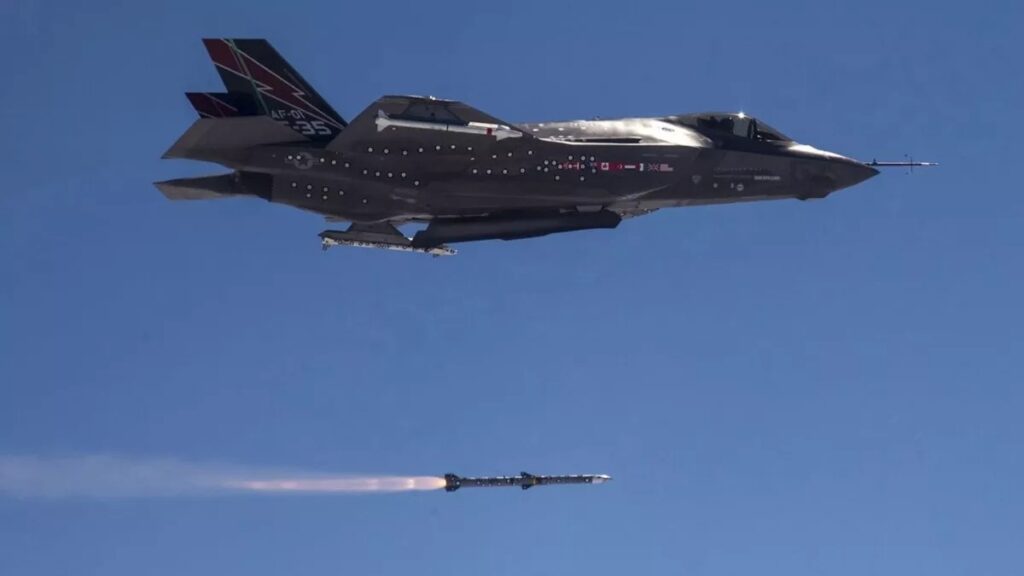
The US War Department announced in a press statement issued in late September that Pakistan was included in the list of countries that will receive advanced medium-range air-to-air missiles from American manufacturer Raytheon.
In a press release issued on September 30, the US War Department reported that an additional US$41 million has been awarded to Raytheon, bringing the total contract value to US$2.5 billion, including the previously awarded contract.
This contract has been awarded for advanced medium range air-to-air missiles C8 and D3 variants and their production. According to the US War Department, the work will be performed in Tucson, Arizona and is expected to be completed by May 30, 2030.
This includes foreign military sales to Pakistan, other countries to which it will be sold include the United Kingdom, Germany, Israel, Australia, Qatar, Oman, Singapore, Japan, Canada, Bahrain, Saudi Arabia, Italy, Kuwait and Turkey.
The official statement said, “Raytheon Company, Tucson, Arizona, has been awarded a $41,681,329 firm-fixed-price modification to a previously awarded contract for the Advanced Medium Range Air-to-Air Missile C8 and D3 variants and their production. This modification brings the total cumulative face value of the contract to $2,470,708,229. It has become $2,512,389,558. The work will be performed in Tucson, Arizona and is expected to be completed by May 30, 2030. This contract covers foreign military sales to the United Kingdom, Poland, Pakistan, Germany, Finland…”.
Dawn reported that the American missiles will be installed on F-16 Falcon aircraft flown by the Pakistan Air Force (PAF).
It further mentioned that Pakistan was not included in the list of buyers of the missile in the contract signed on May 7 for the AMRAAM deal.
Dawn noted that Pakistan had earlier purchased 700 AMRAAMs in January 2007 – the largest international order for the weapon at that time.
The announcement of the AMRAAM missiles comes soon after US President Donald Trump met Pakistan Prime Minister Shehbaz Sharif and Army Chief Asim Munir in September.