
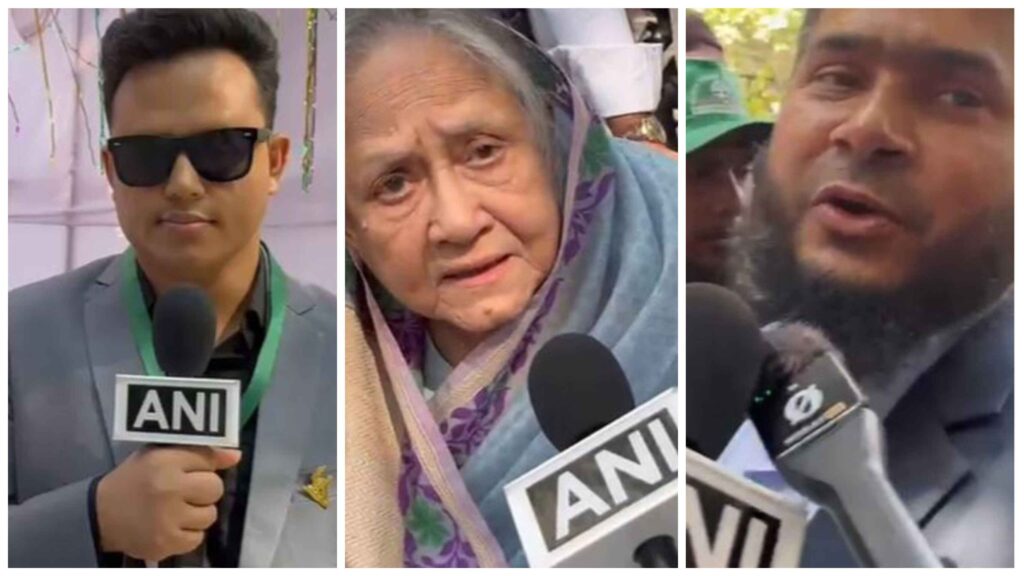
Amid voting for the 13th parliamentary election in Bangladesh, Jamaat-e-Islami candidate Khalidoj Zaman has alleged irregularities in voting at some places.
Addressing media persons, Jamaat-e-Islami candidate Khaliduz Zaman, who is contesting against BNP president Tariq Rahman, said, “The situation is not good because without the polling representative, in a separate room, someone is sealing the papers. This is extremely disappointing. I have seen this happening at many places. We were hopeful that Jamaat-e-Islami would win the election, but if this happens then how can we have hope.”
However, former BNP minister Sarwari Rehman praised the electoral process and expressed hope for positive results after the elections.
After casting his vote, Rehman told ANI, “Everything went very well, and everything is very organised. Women are voting freely. I feel very happy. After so many years, finally the elections are being conducted properly.”
Expressing hope, he said that he hopes everything will be fine after the elections.
“I am hopeful that the outcome will be good and Parliament will be in session. From what we have seen over the years, I think everything will be fine now,” Rehman told ANI.
Zubair, a member of the student wing of Bangladesh Jatiyatabadi Chhatra Dal (BNP), accused Jamaat-e-Islami of disrupting the voting process and told ANI, “Actually the situation is a two-way street. We are trying to control it, but the other big party, Jamaat-e-Islami, is trying to disrupt it. We have evidence that they are boycotting, misleading voters at polling stations and criminal activities are taking place there. They are also casting illegal votes. The expectations of the new generation completely match the expectations of Jamaat-e-Islami.
He accused the party of being involved in criminal activities in the past and said, “In my opinion, they do not have the right to participate in the National Assembly.”
This morning Bangladesh’s interim chief advisor Mohammad Yunus cast his vote at Gulshan Model School and College polling station in Dhaka.
This vote marks a turning point in the country’s political history as the country enters a new phase.
BNP President Tariq Rehman, who cast his vote at Gulshan Model High School and College, Gulshan-2, today said the country was waiting for the election day to exercise its franchise.
Meanwhile, voters across the country flocked to the polls as early as 6 a.m. (local time) forming long queues outside polling stations, reflecting both their anticipation and hope for a transparent electoral process.
The parliamentary elections are being held at a time when a lot of changes are being seen after the death of former Prime Minister Khaleda Zia and the ban on her long-term rival Sheikh Hasina’s Awami League party.
With about 127 million eligible voters, the world’s eighth most populous country is headed to the polls. According to Al Jazeera, almost half of the voters are in the 18-37 year age group, with 45.7 million voters voting for the first time.
There are 59 registered political parties in Bangladesh except Awami League. The Awami League’s registration was suspended by the Election Commission last year, due to which it was unable to field candidates in the elections. Of these, 51 parties are participating in this year’s elections. A total of 1,981 candidates are contesting the election, including 249 independent candidates.
The parties contesting the election are Bangladesh Nationalist Party (BNP), Jamaat-e-Islami. Rashtriya Nagarik Party (NCP), Jatiya Party (JP-Quadre), Jatiya Party (JP-Ershad), Left Democratic Alliance and Amar Bangladesh Party (AB Party).
Corruption, inflation, employment and economic development are the main issues of the election.
Apart from parliamentary elections, a referendum on the National Charter 2025 is also being held in the country. According to Al Jazeera, this document has been prepared by the interim government led by Muhammad Yunus and lays the foundation for the future regime.