
Trump’s entry into the country to seize Venezuelan oil and take away President Maduro is a naked display of bullying with the help of military force.
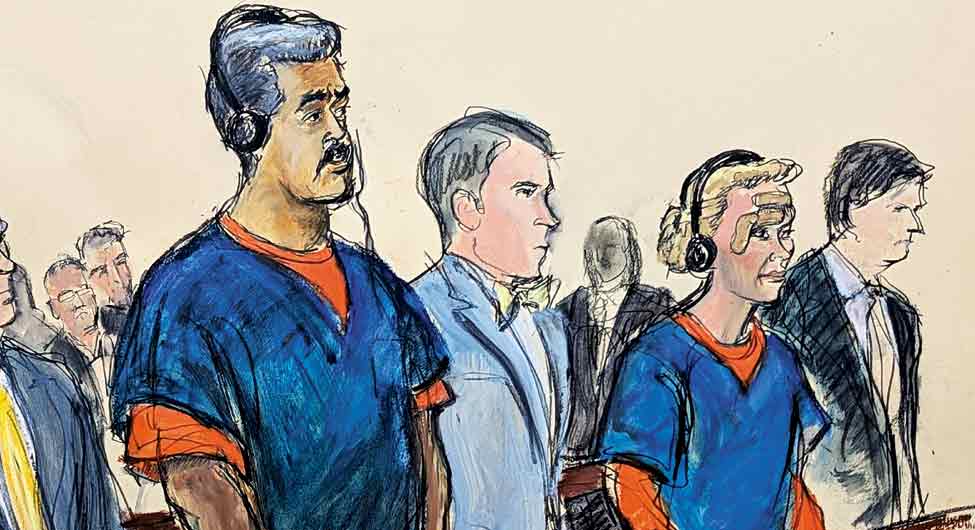
America’s military attack on Venezuela’s capital Caracas is a shameless example of Donald Trump’s blatant bullying. On January 3, the US military kidnapped President Nicolas Maduro and his wife Celia Flores and brought them to New York. This operation coincided with large-scale attacks in several places in Venezuela and was justified under the now common pretexts of drug trafficking, narco-terrorism, dictatorship and national security. This reveals America’s intentions more than Venezuela’s.
This is not by any measure moral authority, constitutional discipline or respect for international law, but a naked display of imperialist power. Like the emperor described in the stories, America is boasting about its dominance and is convinced that whatever it does is justified. The garb of law, principles and generosity that once covered his arrogance have long ago fallen off.
Trump did not create this situation, he simply pushed aside his hypocrisy and pretense. The intentions of America which the previous governments hid in humanitarian talks, multilateral posturing and moral jargon, Trump implemented them with direct threats. In this way they demonstrated what had long been true: the Empire no longer needed any excuses or explanations. He no longer needs to pretend that he had to do it reluctantly, for the sake of goodness. He just wants to get his point across.
The fear is not just about Trump’s nature, but about this nakedness becoming common. When empire gives up even the pretense of justice, what remains is a power free from law and order, a power that no longer needs any pretext. The real danger is the spinelessness that has become a habit in the world, which keeps watching these scenes silently and countless innocent people lose their lives.
false moral excuse
It is intellectual dishonesty to claim that Venezuela is a threat because of drug trafficking. The supply of drugs to the US historically passes through many transit countries, many of which are close US allies. Despite decades of US military aid, intelligence cooperation, aerial spraying campaigns, and counter-narcotics operations, Colombia remains the center of the global cocaine economy. Mexico’s cartels kill more people annually than many declared war zones. Yet neither Bogotá nor Mexico City faces threats of economic damage from U.S. attacks, regime change, or sanctions.
This is not a coincidence, a sign. ‘Drugs’ serves as a moral excuse. This is such jargon, which provides an excuse for giving punishment without trial. If drugs were really the reason for military intervention in Venezuela, the United States would have faced weakness in its allies, its financial system, and its economy. Instead, Venezuela is targeted because it refuses to accept American dominance.
His opposition stance was adopted in Caracas under Hugo Chávez and strengthened under Nicolás Maduro. There it established sovereign control over its resources, opposing US economic policies. Strategic relationships were built with China, Russia, Iran and Cuba and, above all, experiments were done with alternatives to the dollar-based system for oil sales. This is the biggest crime in the eyes of America. That means Venezuela had to suffer the consequences for protesting.
backyard of empire
The American empire has long considered Latin America as its backyard. There has been a proper Monroe Doctrine for this. Then, American intervention in Guatemala, Chile, Brazil and earlier coups during the Cold War has been justified under pretexts like anti-communism, democracy, anti-terrorism, humanitarian rescue, etc.
Trump’s attack on Venezuela is part of that series. It differs only in the method adopted, not in the objective. Previous governments had at least tried to justify intervention through international institutions or the consent of allied countries. Trump even abandoned that etiquette. Venezuela became a domestic political pawn. It became proof that America could still punish ‘socialism’, twist the ears of rebellious countries, and mobilize right-wing voters, especially immigrant communities in Florida.
Without provocation: US bombing in Venezuelan capital Caracas
Electoral manipulation is mixed with imperialist thinking. Venezuela was made a joke. That is, a failed socialist country whose destruction can be sold as an ideological victory. The lives of Venezuelans do not matter, just like those of Iraqis or Libyans before them.
Yet Venezuela is not just a symbol. It has the world’s largest reserves of oil, as well as vast reserves of natural gas, gold, bauxite, coltan and rare minerals. These resources are important not only for energy markets but also for electronics, new technologies, and modern weapons. In a world undergoing energy transition, possession of such resources provides strategic strength.
Since Chávez’s time, Venezuela has resisted large-scale privatization, negotiated new contracts with multinationals, and sought to distribute oil revenues to domestic rather than foreign shareholders. What was even more important was that he started looking for oil trade agreements that were not done through US dollars. This was not just an economic arrangement, it was a political announcement.
sin of anti dollar
Venezuela lost access to the dollar-based financial system by the late 2010s due to increasing US sanctions. In such a situation, Venezuela started diverting oil exports towards Asia, especially China. By the early 2020s, China had become Venezuela’s single largest oil customer, sometimes purchasing 70 to 90 percent of total exports. Much of this crude was sold in non-dollar currencies such as yuan, euro or ruble, often hidden in shipping documents to avoid sanctions.
Exact figures are difficult to find because PDVSA (Venezuela’s state oil and gas company) and Chinese Customs rarely publish currency-specific data. But tanker tracking, refinery intake records and industry analysis show a clear pattern: a large portion of Venezuelan oil was being traded in currencies other than the dollar. Estimates suggest that this transition generated billions of dollars in annual revenue and demonstrated that oil-producing countries could trade without being completely dependent on the dollar.
This was the real crime. The petrodollar system is the basis of America’s global power. Oil trade is forced to go through a US-controlled clearing system through transactions in dollars. Therefore, US sanctions act as financial arm twisting. Even the slightest distance from this system weakens this strength.
Washington remembers Saddam Hussein’s decision to fix the price of Iraqi oil in euros. He remembers Muammar Gaddafi’s proposal for Africa’s gold-based currency. Both had to pay the price of the destruction of their countries. Venezuela’s challenge was small in scale, but its consequences were dangerous. At the peak of production, Venezuela pumped more than 3.5 million barrels of oil every day. Even at low production, the possibility that so much oil could move outside the dollar’s dominance was untenable.
political strategy of economic siege
The catastrophe often cited to justify the intervention occurred after the US action. Freezing assets, denying credit, exclusion from global banking, freezing foreign assets such as CITGO (formerly owned by Petroleos de Venezuela), and secondary sanctions systematically eroded Venezuela’s economic capacity. The shortage of food items, medicines, spare parts and essential commodities was not just the result of the local government’s mistakes. The reasons were also economic siege.
blatant bullying
America’s supporters insist that American power is bound by constitutional rules. Formally, the Constitution gives the right to wage war to Congress and its command to the President. In practice, this framework has become hollow over the decades.
Since World War II, US presidents have repeatedly initiated military action without declaring war. Its examples are Korea, Vietnam, Iraq, Libya, Syria etc. The War Powers Resolution of 1973 was meant to prevent such arbitrariness. Instead, it has become an inconvenience of process, avoided by manipulation of words: wars have been renamed as ‘operations’, attacks have been re-branded as ‘defensive attacks’.
The deeper problem is Congress’s retreat from its responsibility. When force is used against vulnerable Southern Hemisphere countries, Parliament waives its authority out of political convenience or bipartisan consensus. Therefore, Trump’s threats against Venezuela expose constitutional weakness.
The use or threat of force against any sovereign state is prohibited under the UN Charter. The only exceptions are actions in self-defense following an armed attack or with the authorization of the Security Council. None of these conditions apply in the case of Venezuela. Drug trafficking, economic mismanagement, dictatorship, or ideological distance do not constitute legal grounds for war. Therefore, every military action of America will be considered an attack.
Venezuela is not isolated. It is linked in a network of strategic relations with China and Russia. Beijing has invested billions of dollars in Venezuela’s energy and infrastructure. Moscow has provided military equipment, advisers and loans. Therefore, threatening Venezuela is not just regional bullying; This is a challenge to rival powers in the Western Hemisphere.
the empire unmasked
Trump stopped pretending it was covered up. Previous governments have tried to portray American power as reluctant, committed to restoring democracy and bound by rules. Trump openly talks about threats, sanctions, ultimatums. In this way he exposed the truth which had been hidden for a long time that the empire is not run by consent, but by force.
The future of Venezuela will be decided by the Venezuelan people. But the questions raised by Trump’s actions will not go away. Are we moving towards a world where power alone determines legitimacy? Where the law is used selectively and ignored as per convenience? Where de-dollarization is considered a major crime?
(The author is a well-known columnist and human rights activist. Views are personal)