
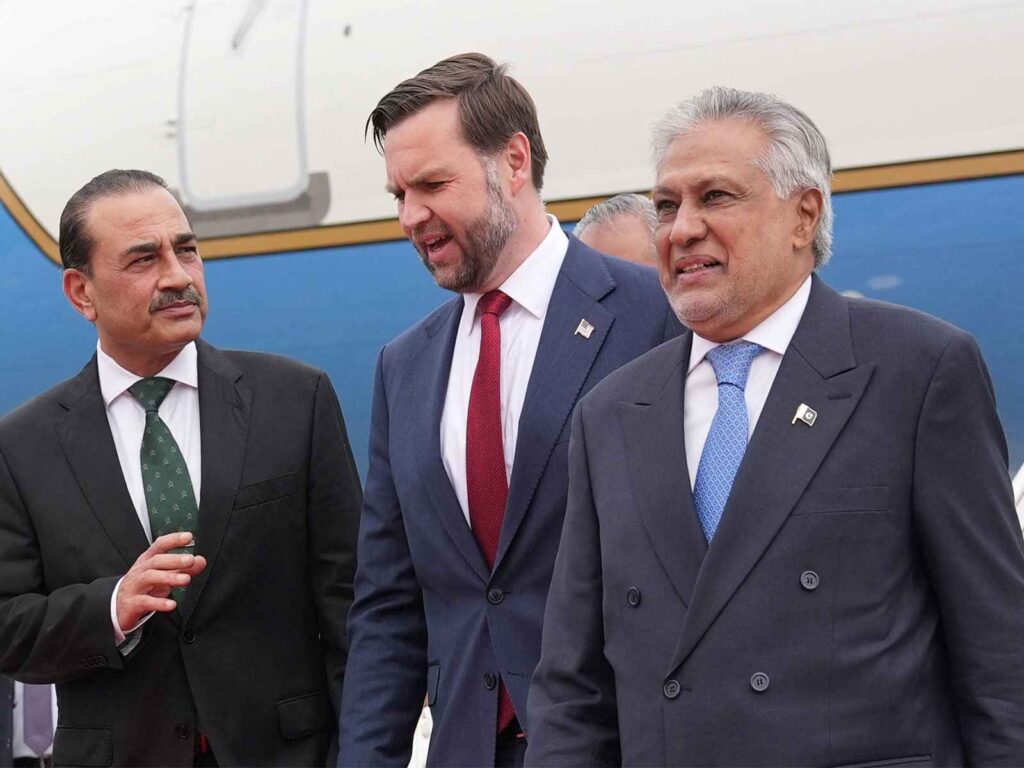
As the world’s eyes are fixed on the uncertain ceasefire talks, Al Jazeera quoted its sources as saying that an American plane carrying a team for talks with Iran has landed in Islamabad, Pakistan.
The Iranian delegation led by Parliament Speaker MB Ghalibaf arrived after midnight. According to Al Jazeera, the US team includes chief negotiator Vice President JD Vance, special envoy Steve Witkoff and President Donald Trump’s son-in-law Jared Kushner.
Following the ceasefire announcement last week, Iran’s Supreme National Security Council said on April 8 that talks could continue for 15 days.
Pakistani Prime Minister Shehbaz Sharif described the talks between the US and Iran as a “do or die” situation, Al Jazeera reported.
When the Iranian team aircraft entered Pakistani airspace, it was provided with a full circle of security that included AWACS (Airborne Warning and Control System) early warning aircraft, electronic warfare aircraft, as well as fighter jets, which escorted the Iranian team to Islamabad.
“Iran’s negotiating team led by Parliament Speaker Mohammad Bagher Qalibaf has arrived in Islamabad. Qalibaf is accompanied by Foreign Minister Abbas Araghchi, Defense Council Secretary Ali Akbar Ahmadine, Central Bank head Abdolnasser Hemmati and several MPs,” Iran’s embassy in India said in a post on Twitter.
He was welcomed by defense forces chief Asim Munir, Foreign Minister Ishaq Dar and Interior Minister Syed Mohsin Raza Naqvi, Al Jazeera reported.
Roads leading to Islamabad’s Red Zone, where Parliament, key government establishments, luxury hotels, embassies and offices of foreign organizations are located, remained blocked as the Pakistani capital prepares to host peace talks with the US and Iran.
The main point of contention between the two sides is Iran’s 10-point plan, which is the basis of peace talks. The US wants to reach a deal and keep the Strait of Hormuz open and prevent Iran from continuing uranium enrichment.
After Iran termed the 15-point peace proposal sent by the US as “extreme”, Trump described the plan as “viable”.
Iran in India posted on X, “Iran’s 10-point terms that the US has accepted as ‘workable’: The US is fundamentally committed to the following: Non-aggression; Iran’s continued control over the Strait of Hormuz; Acceptance of enrichment; Removal of all primary sanctions; Removal of all secondary sanctions; Nullification of all UN Security Council resolutions; Nullification of all IAEA Board of Governors resolutions; Compensation to Iran; withdrawal of US combat forces from the region; end of war on all fronts, including Lebanon’s heroic Islamic resistance.”
Hours after the ceasefire, US officials and President Trump gave mixed reactions as to Washington’s understanding of Iran’s proposal and the main points of the document. According to Al Jazeera, Vance described the publicly circulated version as nothing more than “a document made publicly available by some clueless person in Iran”.
America had presented a 15-point plan aimed at reducing tensions between the long-term enemies. “Iran is committed to not developing nuclear weapons: Iran must also stop uranium enrichment within the country and hand over its stockpile of already enriched uranium to the International Atomic Energy Agency (IAEA),” Al Jazeera said, citing excerpts from the plan published by the media.
These points further stated, “Tehran would also commit to allowing the IAEA to monitor all elements of the country’s remaining nuclear infrastructure; reopening the Strait of Hormuz; ending Iran’s support for regional proxy organizations such as Hezbollah in Lebanon and the Houthis in Yemen.”
The peace plan proposed by the US calls for, “Removing all sanctions imposed on Iran, as well as ending the UN mechanism that allows sanctions to be reimposed; imposing restrictions on the range and number of Iran’s missiles.”
The confusion arose because the Persian version of the plan differs significantly from the English version on the key point of Tehran’s right to enrich uranium.
Trump later clarified what the officials were going to discuss. He said, “There is only one meaningful set of ‘points’ that are acceptable to the United States, and we will discuss them behind closed doors during these negotiations.”
During the talks, Israeli Prime Minister Benjamin Netanyahu said that although Israel welcomes the ceasefire, attacks on Lebanon will not stop and they will continue their mission to eliminate Hezbollah.
Earlier in the day, Al Jazeera reported that an Israeli airstrike targeted a residential building in the town of Mayfadoun in the Nabatieh district of southern Lebanon, killing three people and completely destroying the residential building.