
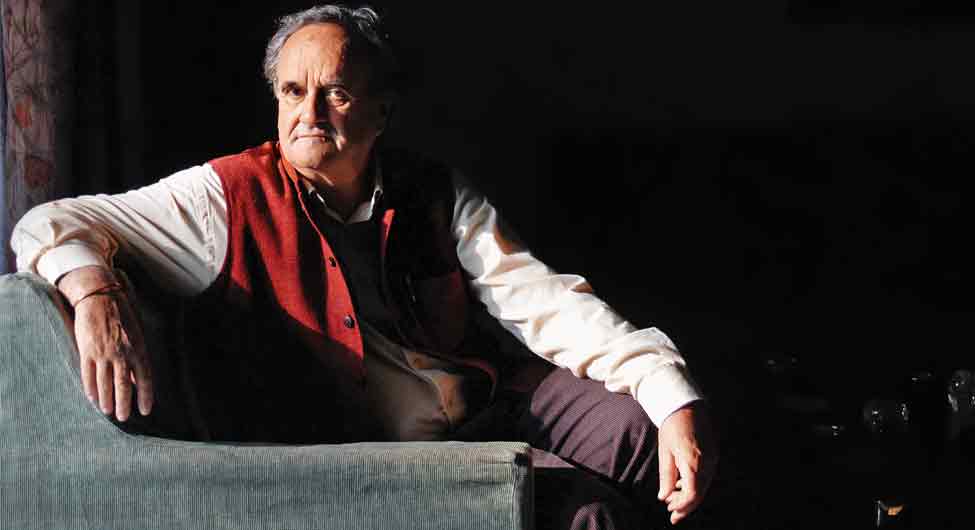
The death of famous journalist Mark Tully, who was considered a symbol of true and accurate news, provides us an opportunity to look at how to stop false and misleading news.
It is as important for journalists to be impartial as it is to deliver correct and authentic news to the people. These two qualities should definitely be found in the DNA of those who follow the religion of journalism. Every media person is expected not to suffer from any kind of bias in the process of collecting news, writing and publishing it. Neither work under any pressure, nor be influenced by any fear or temptation. In fact, only an unbiased journalist is reliable in the eyes of readers or viewers.
A reporter’s language can make him better than others, his art of presenting news can be unique. Someone’s news sense can make him a high-quality journalist, while someone’s passion to go to the bottom of the news and research can add new chapters to investigative journalism. But, apart from all these qualities, what makes a journalist special is to remain impartial throughout his career.
It has often been seen that many talented journalists are unable to live up to the standards of journalism due to their biases, personal commitment to a particular ideology or other professional compulsions. Obviously, without credibility no media person exists. The importance of fairness and credibility can also be understood from the example of Mark Tully.
Famous journalist Mark Tully died recently in Delhi at the age of 90. He was the chief correspondent of the British Broadcasting Corporation (BBC) in India for decades, but due to the credibility of his news, he made a special place for himself among many foreign correspondents.
As the chief correspondent of BBC in India, he came to be considered a symbol of true and accurate news. From the beginning of the seventies to the nineties, his listeners on radio, from the metropolitan cities of India to the remote villages, were assured that his news would be both correct and authentic. Only a few journalists get such credibility or reputation in their career.
Mark Tully also worked as the South Asian correspondent for the BBC, during which he covered many history-changing events not only in India but also in Pakistan and other neighboring countries, be it the Emergency in 1975, the assassination of Prime Minister Indira Gandhi in 1984 and the subsequent anti-Sikh riots and Operation Blue Star.
He was one of the first reporters to reach ground zero for news ranging from the Bhopal gas leak tragedy to the demolition of Babri Masjid. His understanding of the socio-economic-political conditions of India was rarely seen among his contemporary reporters.
This is why Mark Tully’s demise is being seen as the end of a chapter of journalism in India. Till the last years of his life he remained a symbol of excellent journalism. His reporting undoubtedly inspired generations of journalists. He will remain an example for every future generation of journalists.
Mark Tully’s contribution needs to be further understood in today’s times, especially when true, accurate and authentic news has been replaced by fake news. Today, in the race to disseminate news, the process of fact checking is being considered unnecessary. Technologies like Artificial Intelligence and Deep Fake have put a big question mark on the credibility of news.
Today it has become difficult to understand which news is true and which is not. The world of news has left the era of ‘breaking news’ far behind. In the cut-throat journalism of the digital era, what has become more important is which news will reach how many people and how quickly.
Due to the desire to get more and more subscribers and their likes, misleading and false news is often served through YouTube, Insta Reel or other digital mediums of social media, whose views reach millions within a short time. This is the biggest challenge of the modern era of journalism. There is a need to think seriously about how to stop such false and misleading news. If this trend continues then what will be the future of journalism and will a journalist like Mark Tully emerge whose news people will blindly believe?