
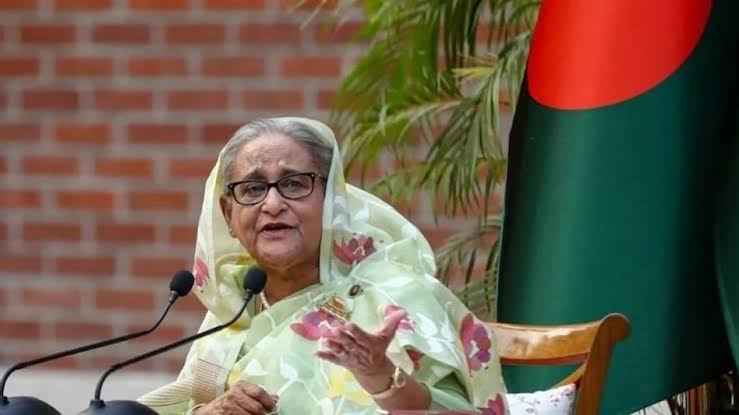
A Bangladesh court on Monday afternoon found ousted former Prime Minister Sheikh Hasina guilty of “crimes against humanity” during the July-August insurgency in 2024. Local media reported that the International Criminal Tribunal-1 has sentenced Hasina to death.
The tribunal found the former prime minister guilty on all five counts of crimes against humanity, the Dhaka Tribune reported.
The news outlet further said that the landmark verdict concludes that Hasina and two other accused, former police chief Chaudhry Abdullah al-Mamun and former interior minister Asaduzzaman Khan Kamal, planned and enabled atrocities during the July–August movement.
The Awami League leader, who is currently in exile in India, was tried in absentia. The 78-year-old leader had fled to New Delhi after the fall of her government in Dhaka.
According to Al Jazeera, the International Criminal Tribunal said, “Accused Prime Minister Sheikh Hasina has committed crimes against humanity through her provocative order, and also by failing to take preventive and punitive measures under charge 1.”
“Accused Sheikh Hasina has committed crimes against humanity by ordering the use of drones, helicopters and lethal weapons under charge number 2,” the special tribunal said.
Bangladesh Television broadcast live the proceedings of Justice Ghulam Murtaza, head of the country’s International Criminal Tribunal-1, the three-member tribunal overseeing the case. He read the verdict on Monday afternoon.
The tribunal said Hasina “ordered the killing of protesting students” during the unrest in July–August, Bangladesh News 24 reported.
The three-member bench, comprising Justice Mohammad Shofiul Alam Mahmood and Justice Mohammad Mohitul Haq Inam Chaudhary, entered the courtroom at around 9:55 am and the proceedings began at 12 noon. According to Bangladesh News 24, the decision is being telecast live.
Former police chief Chaudhry Abdullah al-Mamun, the only accused currently in custody, was brought into the court cell at 9am. He has already confessed to his crime and has turned government witness.
Two other accused – Hasina and former home minister Asaduzzaman Khan Kamal – have been declared fugitives and are being tried in absentia. Both had fled to India after the Hasina government was ousted on August 5 during the student-led rebellion.
On 10 July, the tribunal indicted Hasina, Asaduzzaman and Mamun on five charges of inciting, ordering the killing of 1,400 people to suppress the July Uprising, “high command responsibility” and “joint criminal enterprise”.
Hasina was ousted from power on August 5, 2024 and fled to India after a student-led mass revolt. It is believed that Asaduzzaman is also in India. Since then the trial is going on in his absence.
According to Bangladesh News 24, both have been shown as fugitives.
Chief prosecutor Tajul Islam told reporters last week that prosecutors had sought the death penalty for Hasina and Asaduzzaman. We have demanded maximum punishment in the court. The court will use its discretion, and we pray that the accused be given the maximum punishment for this crime.
Families of some of the victims were present at the tribunal on Monday, many of whom demanded the harshest punishment. Security was increased in the court premises and surrounding areas since morning before the verdict.
Meanwhile, Hasina’s party, the Awami League, has again announced a “complete shutdown” on Sunday and Monday in protest against the decision. As part of the programme, sporadic crude bomb blasts and vehicles being set on fire have been reported in several parts of the country, including Dhaka. Now Sheikh Hasina, head of the banned Awami League party, faces a total of five charges.
These include planning the mass killing of protesters in Dhaka, the use of helicopters and drones to fire on civilian crowds, the killing of student activist Abu Saeed, the burning of bodies in Ashulia to destroy evidence, and the coordinated killing of protesters in Chankharpul.
The case against Hasina and her two associates pertains to crimes committed during student protests against the government from July 15 to August 5, 2024.
The formal chargesheet runs into 8,747 pages, including references, seized evidence and a detailed list of victims, the Dhaka Tribune reports. Hasina, who fled the country in August 2024, has been living in New Delhi since then.
According to prosecutors, Sheikh Hasina made inflammatory remarks at a press conference at Gana Bhawan on July 14, 2024, after which law enforcement personnel and ruling party workers allegedly launched systematic attacks on students and civilians.
According to the Dhaka Tribune, the ICT Tribunal investigated whether Hasina, Kamal and Mamun instigated, supported or allowed these attacks, and whether they failed to prevent or punish the murder, attempted murder and torture committed during the crackdown.
The former Prime Minister of the country is accused of ordering the use of helicopters, drones and ammunition to stop the protests. Kamal and Mamun allegedly disseminated and implemented these orders through their chain of command and prosecutors say these amounts to crimes against humanity through command, incitement and conspiracy.
The three are accused of shooting dead Abu Saeed in front of Begum Rokeya University on July 16, 2024. The prosecution alleged that the killing was carried out on the instructions of top political and security leadership, holding them responsible for ordering, aiding and abetting the attack.
On August 5, 2024, six students were shot dead during a law enforcement action in the Chankharpul area of Dhaka and Hasina, Kamal and Mamun were held responsible for the action that led to the deaths.
Also on August 5, 2024, six people were shot in Ashulia; Five bodies were burned, and a sixth person, who was still alive, was reportedly burned with them. According to the Bangladeshi News Agency, prosecutors say the murders were committed with the knowledge, connivance and permission of the accused.
Defense lawyer Mohammad Aamir Hussain has dismissed the allegations as “false and fabricated”. He said there was no documentary evidence that Hasina had ordered any killing and that, according to the Dhaka Tribune report, an “isolate group” carried out the violence, causing instability in the country.