
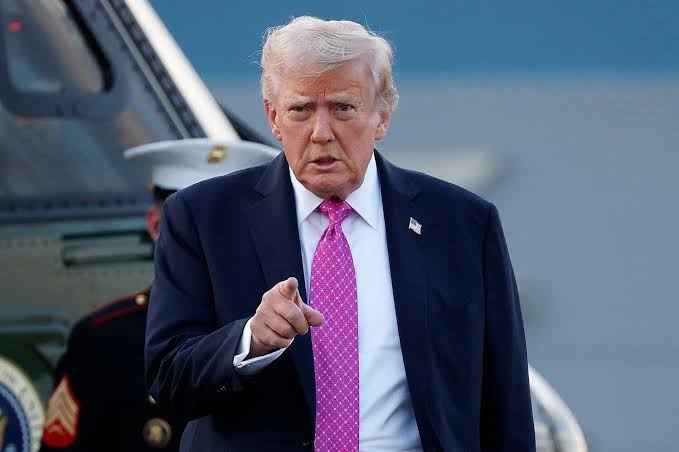
US President Donald Trump left for his Asia trip on Friday. Where he will visit Malaysia, Japan and South Korea. The three-nation visit will begin in Kuala Lumpur, Malaysia, where Trump will visit Japan and South Korea after attending the ASEAN summit.
At the end of the visit, he will hold talks with Chinese President Xi Jinping, the White House said.
White House spokeswoman Carolyn Leavitt told reporters on Thursday that Trump will meet Xi in South Korea on the morning of October 30 before returning to Washington.
Trump is expected to reach Malaysia on Sunday (October 26) morning. Malaysia currently chairs the annual meetings of the 10-member Association of Southeast Asian Nations (ASEAN) and its allies.
He will attend the ASEAN summit on October 26-27, which will be his first participation after missing the summits in 2018, 2019 and 2020.
During his stay in Kuala Lumpur, Trump will hold a wide-ranging bilateral meeting with Prime Minister Anwar Ibrahim on Sunday afternoon. He will also attend a signing ceremony with the prime ministers of Cambodia and Thailand, whose countries had a brief border clash in July that left dozens dead and many displaced.
Later, he will attend a working dinner with US-ASEAN leaders.
The White House stressed that the visit will include trade talks, peace talks and discussions on US-China tensions. After Malaysia, Trump will travel to Japan to meet with new Prime Minister Sanae Takaichi, where they will discuss trade deals and security cooperation.
After Japan, Trump will visit South Korea to attend the Asia-Pacific Economic Cooperation (APEC) CEO summit in Gyeongju. He will meet with President Lee Jae-Myung and address business leaders, further strengthening U.S. engagement with the region.
The crucial bilateral meeting with Chinese President Xi Jinping will focus on trade tensions, rare earth exports and fentanyl cooperation.
Through these meetings, Trump aims to negotiate favorable trade agreements, reduce tariffs, and boost US exports, with his return to Asia potentially redefining regional trade and diplomacy.