
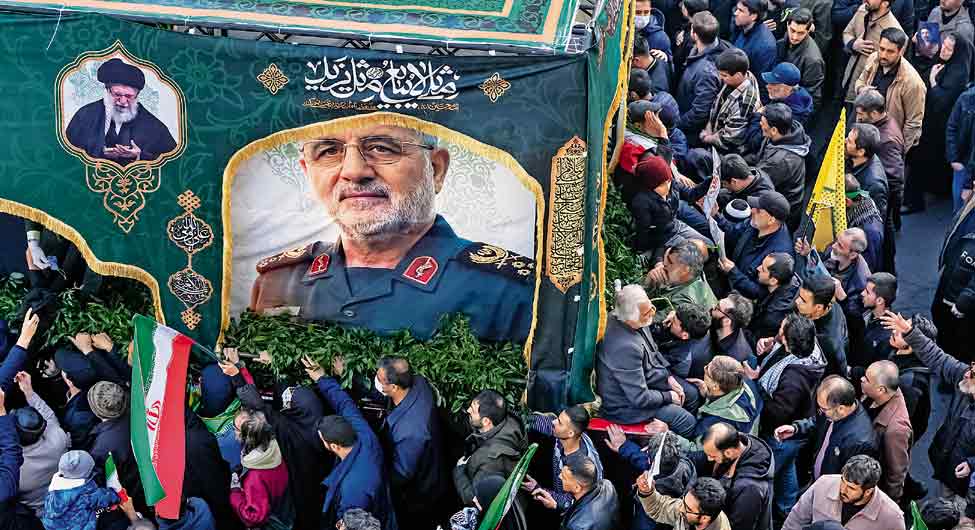
IRGC is one of the powerful military agencies of West Asia.
The changes in the modern Iranian power structure are clearly visible in the maze-like streets of the Grand Bazaar in the capital, Tehran. Earlier there used to be the secret police of pro-Western royal sultanates and now after the Islamic Revolution, the Islamic shadow army i.e. Islamic Revolutionary Guard Corp (IRGC) is the most important force. Born out of the 1979 revolution, this army has become the most important force in West Asia. It provides all kinds of help to armed groups from Lebanon to Latin America. Its role is most special in the Israel-America war with Iran.
To understand the rise of IRGC, it is important to remember the era of Iran’s last emperor Mohammad Reza Shah Pahlavi. Iran was one of America’s closest allies in the region during the Cold War. The Shah, who came to power in 1953 after the overthrow of the democratic government in Iran with the instigation of American and British intelligence agencies, strengthened his hold and took steps towards modernization and gained complete control over power. In 1957, with the help of the US Central Intelligence Agency (CIA), the Shah formed SAVAK, Iran’s national intelligence and security service. The number of SAVAK agents was more than 6,000. They were not just spies but ‘watchmen of terror’. SAVAK ensured that no negative news about Shah reached the people.
The revolution broke out from the same cycle of repression, to prevent which this entire system was created. By the late 1970s, economic inequality, political repression, and growing resentment toward the West led to large-scale protests. The most powerful voice of that movement was found in the form of exiled religious leader Ruhollah Khomeini. The monarchy collapsed in 1979 as a result of the Iranian Revolution. The problem facing the new regime was that the Shah had a strong hold on the country’s formal army. The leaders of the revolution were afraid that this army might carry out a ‘coup’. Khomeini formally established the IRGC in April 1979. The basic condition of the IRGC is ‘commitment to ideology’. However, during the Iran–Iraq War (1980–1988), the IRGC transformed from a mere militia to defend the Islamic Republic into a powerful army.
Millions of people were killed in the eight-year long war and Iran’s security structure also completely changed. Its formal army was fighting on the front, but the IRGC developed strategies that later became part of Iran’s military strategy. These strategies were guerrilla campaigns for unequal warfare and the use of fighters who sacrificed their lives for the ideology. Such fighters found it better to join the IRGC and not the army. It offered better wages and opportunities for social advancement, and thus attracted some of Iran’s best and brightest youth. By the end of the war, the IRGC had become a parallel military structure, which had immense political influence.
The IRGC and its associated military and intelligence agencies number millions of youth, including the Basij militia, a paramilitary force that provides internal security and intelligence gathering.
Over the past three decades, the IRGC has become deeply entrenched in Iran’s economy. It has won many large infrastructure project contracts including pipelines, ports and telecommunications networks through large groups such as ‘Khatam Al-Anbiya Construction Headquarters’. Many strategic industries moved into semi-governmental networks dominated by the IRGC. Many of its former members have also joined politics in large numbers. Many ministers, MPs and even former President Mahmoud Ahmadinejad have once served in this guard.
Inside Iran, the IRGC plays the role of both a protector and a political agency. This force is particularly instrumental in maintaining the internal security of the country through the ‘Basij Militia’, which has played an important role in suppressing major protests in the last two decades.