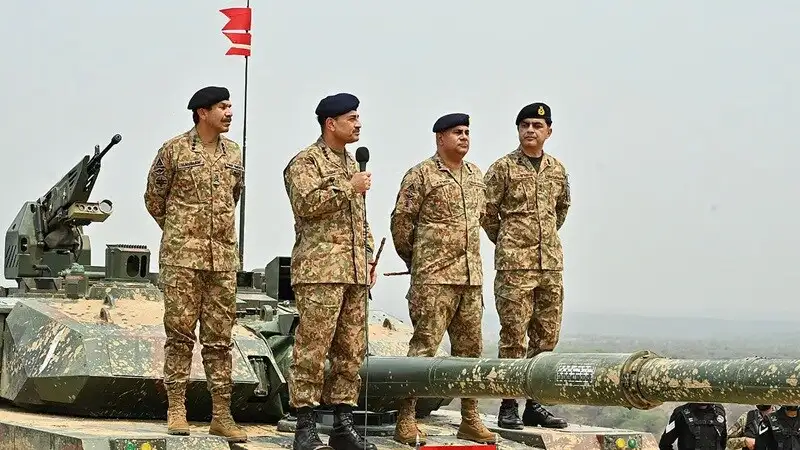
This rivalry was no longer limited to two or three wars. Modern warfare, cyber operations and political-diplomatic strategies have given a new shape to this rivalry. In preparation for this new era, Pakistan has taken an important step. It has given more constitutional legitimacy to the army by amending its constitution. In other words, the Pakistani Army has now become even more powerful there. Pakistan Law Minister Azam Nazir Tarar on Saturday introduced the 27th Constitution Amendment Bill in the Upper House of Parliament. The Bill proposes to formally give constitutional status to the appointment of the chiefs of the three services – Army, Air Force and Navy – and their respective posts by amending Article 243 of the Constitution. Tarar said, “The recent tension with India has taught us many lessons. The nature and tactics of modern warfare have completely changed. Therefore, it is now necessary that we adapt our constitutional framework to the new security scenario.”
Will Pakistan’s ‘Kavach’ be able to save it from ‘Operation Sindoor’?
According to reports, India’s Operation Sindoor is behind Pakistan’s decision to equip its army with “constitutional armour”. On 7 May, India launched a major attack on terrorist bases operating in Pakistan and PoK to avenge the Pahalgam attack. There were reports of killing of more than 100 terrorists and destruction of camps of Jaish-e-Mohammed and Lashkar-e-Taiba. This decisive action by India created a stir in Pakistani political and military circles. After three days of tension, both countries declared a ceasefire on 10 May. After suffering heavy losses in this conflict, the Pakistan Army began to introspect on whether its command structure was suitable for modern warfare. Despite being badly defeated in this conflict, Pakistan Army Chief General Asim Munir used his influence to get himself promoted to the rank of Field Marshal. He is the second Pakistani military officer to receive this post. Earlier, former President Ayub Khan himself had held the title of Field Marshal.
Is Munir making any move to increase his power?
Experts say the new constitutional amendment proposal is another move by Asim Munir, who is trying to further strengthen his position in the ruling party. The constitutional amendment proposals introduced by the Shahbaz government will provide constitutional recognition to the powers of the Army Chief and equivalent posts.
According to analysts, this change could provide a constitutional basis to Asim Munir’s role as Field Marshal. Munir would then be able to maintain permanent influence as the chief military advisor to both the Prime Minister and the President. However, many in Pakistan disagree with this proposal. Many political parties and civil society organizations believe that this move is actually an attempt to centralize military power. According to critics, this is not a modernization of the defense structure, but an attempt to elevate the army above the Constitution.
‘Was the amendment really necessary?’
According to a report in Pakistani newspaper Dawn, the country’s legal and constitutional experts are divided on this amendment. They argue that it is possible to create a modern command structure or a post like the Chief of Defense Staff (CDS) without amending the Constitution. Legal experts argue that such provisions can be implemented through ordinary laws or Defense Ministry regulations. Constitutional amendment is required only when a new constitutional institution is being created.
Experts believe that the amendment to Article 243 is merely an excuse to remove ambiguities regarding the position of Field Marshal and his tenure. The 26th Amendment increased the tenure of the Army Chief from three to five years. However, the current army chief was appointed under the old law, and questions are now being raised over the constitutional validity of his new post.
A ‘race of preparation’ in the India-Pakistan rivalry
Analysts believe that this step is reminiscent of Pakistan’s old tradition in which a new round of security reforms is started in Islamabad whenever India achieves any strategic success. In recent years, India has created an integrated system like Chief of Defense Staff (CDS) in its defense structure, while now Pakistan is also trying to constitutionalize its command system in the same direction.