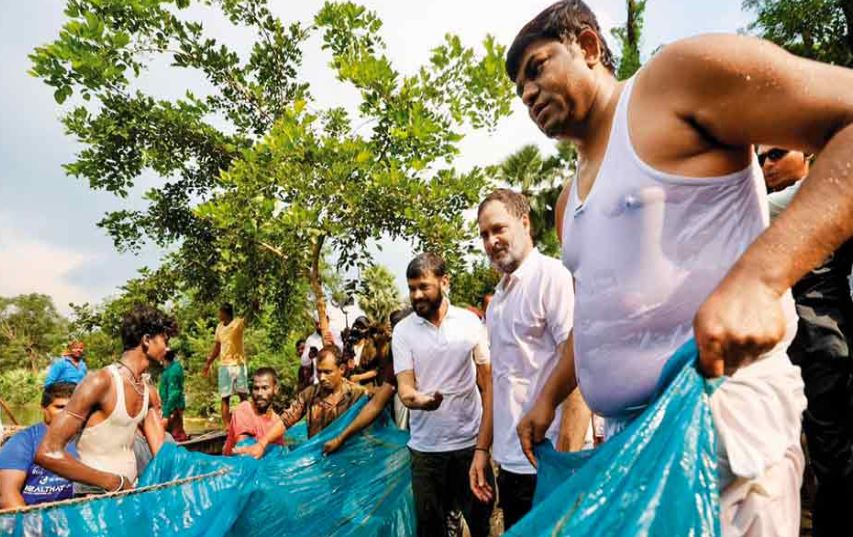
All parties in Bihar are trying to woo the extremely backward class, this 36 percent population is important for both the main contenders.
Naresh Sahni, 50, of Muzaffarpur, about 90 km from Patna, says, “The government will be formed by whoever gets the votes of 36 percent of the population.” The ’36 percent’ he is referring to is the extremely backward class or EBC of Bihar. This is a group of more than a hundred different small castes. Of these, about 10 percent Muslims are from extremely backward class communities. Sahni himself also comes from this extremely backward class. The Sahani or Mallah community consists of about 20 sub-castes. Political efforts are being made to woo the most backward castes known as Panchpaniya.
Prime Minister Narendra Modi also started the election campaign from the village of former Chief Minister Karpoori Thakur. Last year the Central Government gave him Bharat Ratna. Thakur, of the Barber caste, was a prominent EBC leader in the state. While Janata Dal (U) started the Ati Pichda Samvad Rath Yatra in September, Rashtriya Janata Dal made Mangni Lal Mandal, a member of the Dhanuk community, the president of Bihar. Congress also established the Extremely Backward Class Cell for the first time, which is headed by Shashi Bhushan Pandit of the Potter caste. Congress leader Rahul Gandhi also met members of backward castes. In the grand alliance, Mukesh Sahni’s Vikassheel Insaan Party and influential Tanti caste leader IP Gupta are also trying to mobilize the EBC castes.
Learn More Health & Fitness Products Online Magazine Travel Magazine Cookware Politics News Real Estate Investing Guides Video Editing Tools Archive Content Money News Photo Gallery
The EBC comprises more than 100 castes, mostly carpenters, potters, blacksmiths, barbers and washermen. The remaining small castes include Teli 2.81 percent, Mallah 2.6 percent, Kanu 2.21 percent and Dhanuk 2.13 percent. In this way it is an important group of 120 subspecies. Two lists of backward castes were made, Annexure 1 and Annexure 2. ‘Extremely Backward’ were included in the first list, but action was delayed due to lack of data. In 1971, Chief Minister Karpoori Thakur constituted a 20-member commission to identify the most backward castes, but it had to be dissolved. Later the same year, then Chief Minister Bhola Paswan Shastri established the Mungerilal Commission under the leadership of freedom fighter and former minister Mungerilal.
The previous list of backward classes included 94 castes, which increased to 128 in the review of the Mungerilal Commission. In its 1976 report, the Commission described 94 of them as extremely backward socially and economically. When Karpoori Thakur again became the Chief Minister in 1978, he accepted the Mungerilal Commission report and implemented reservation. In government jobs, provision was made for 12 percent reservation for OBCs, eight percent for extremely backward classes, and three percent each for women and economically backward upper castes.
Learn More Entertainment News Business News Subscriptions Photo Printing Services Food Magazine Entertainment Show Tickets Travel Magazine Newspaper Subscriptions Fashion Accessories Financial Planning Services Magazines
When Lalu Prasad Yadav came to power in 1990, he increased the EBC reservation to 14 percent, which was later increased to 18 percent after the separation of Jharkhand in 2000. Lalu Prasad Yadav was aware of mobilization before the 1995 assembly elections. During his campaign, he often said that a genie would emerge from the ballot box and that is exactly what happened. Most backward castes, Dalits, Muslims and Yadavs voted for him in large numbers. He won 167 seats and became the Chief Minister for the second time.
When the extremely backward people got respect, they also started demanding political participation. As Lalu’s tenure progressed, the Yadavs began to consider themselves dominant and reports of their atrocities on Dalits and extremely backward people began to emerge. Under Lalu’s rule, the representation of extremely backward people in the government was negligible. Despite constituting 32 percent of the population, they constituted only five percent of the MLAs.
By 2005, the extremely backward castes, non-Yadav backward castes and Pasmanda Muslims rallied behind Nitish Kumar, whose alliance with the BJP also secured upper caste and Bania votes. Nitish made four ministers from extremely backward castes in his first cabinet and reserved 20 percent posts in Panchayat for extremely backward castes. More than 50,000 extremely backward caste representatives won in the 2006 Panchayat elections.
The extremely backward classes, which were once Lalu’s ‘genies’, have now become Nitish’s most reliable vote bank. Hindu extremely backward castes constitute one-fourth of the population, so they are now demanding proportional representation. JDU has fielded 19 extremely backward caste candidates, BJP 10 and RJD 21 candidates, which includes five Muslim extremely backward castes.