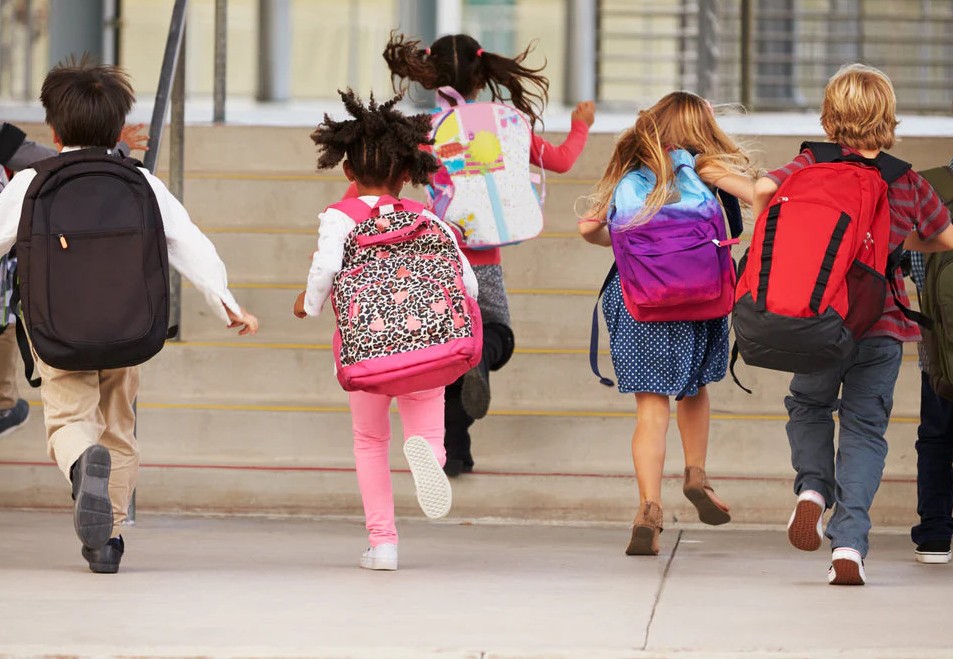
Government Strict on Heavy school Bags of Children: Paragraph 4.33 of the National Education Policy 2020 clearly states that NCERT, SCERT, schools and teachers will together take concrete steps to reduce the weight of children’s school bags.
Under this, an expert committee of CBSE, NCERT, Kendriya Vidyalaya Sangathan and Navodaya Vidyalaya Sangathan had prepared the school bag policy, in which the maximum weight of school bags was decided for each class.
The Ministry of Education asked to implement this policy in all the states, but till now no significant improvement is visible in the situation at the ground level. Even today, small children go to school with heavy school bags, which is having a bad effect on their health.
Question raised in Parliament, government gave written answer
Questions were also raised in Parliament regarding the increasing weight of school bags. In its written reply, the government clearly said that it is necessary to reduce the weight of school bags and 10 bagless days will be compulsorily included in the annual calendar of all schools in the country.
How much weight is prescribed for which class?
In response to the question of MP Ramveer Singh Vidhuri, the Education Ministry told the Lok Sabha that according to the new education policy, there is no need for pre-primary children to carry school bags.
The weight of school bags for first and second class students has been fixed at 1.6 to 2.2 kg. For children of third to fifth class, this limit has been kept at 1.7 to 2.5 kg. It has been fixed at 2 to 3 kg for classes VI and VII, 2.5 to 4 kg for class VIII.
The weight of the bags of students of classes IX and X should not exceed 2.5 to 4.5 kg, while for classes XI and XII this limit has been kept at 3.5 to 5 kg.
What does the school bag policy say?
As per the recommendation of the school bag policy, the weight of children’s school bags should not exceed 10 percent of their body weight. However, this rule does not seem to be followed in most schools.
Experts say that instead of decreasing, the weight of the bag is continuously increasing, due to which children have started having problems related to back, shoulders and neck.
Concerns of MPs and parents
MP Ramveer Singh Vidhuri, who raised this issue in Parliament, says that the weight of children’s school bags has been discussed in the country for years, but no concrete steps have been taken till now.
He said that as a parent, he himself has seen small children getting troubled by carrying heavy bags. Under the new education policy under the guidance of Prime Minister Narendra Modi, the limit of school bags has been fixed and the beginning of Bagless Days is a good initiative.
But the government will have to keep a constant eye on this, because some private schools in collusion with the publishers distribute more books, the burden of which has to be borne by the children.
Parents association expressed concern over increase in school bags
Delhi Parents Association President Virendra Singh says that the increasing weight of school bags has now become a serious problem.
It is the responsibility of the education departments of the states to strictly implement the policy of the Union Education Ministry and stop the arbitrariness of schools.
What are bagless days?
It will be mandatory to include 10 bagless days in the annual calendar of all schools in the country. The Union Education Ministry had issued guidelines for this on 29 July 2024.
In the guidelines issued for students of classes 6th to 8th, it has been said that every school will have to follow it. Indoor and outdoor activities will be organized for the students during these days.
Schools have been advised to fix five days each, twice a year, when students will come to school without bags. Just as schools make an annual academic plan before the start of the new session, the schedule of bagless days will also have to be included in the same plan.
During Bagless Days, students will get an opportunity to meet experts from different fields like artists, sportspersons, animation experts, graphic designers and fashion designers, so that they can gain practical experience along with studies.