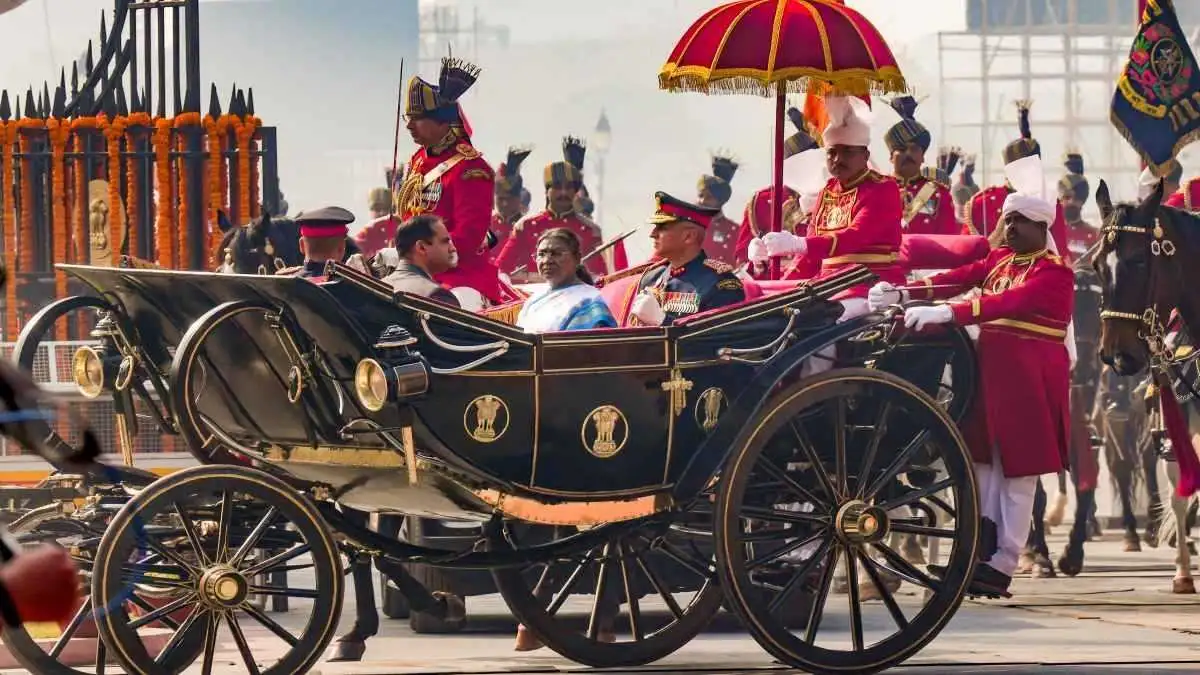
Every year, the procession of the President’s royal carriage on Republic Day is considered one of the most important attractions of the celebrations. This year too, when the President, accompanied by top leaders of the European Union, came on the Path of Duty (earlier Rajpath) in the royal carriage, people’s curiosity increased. Everyone’s eyes were fixed on the magnificent carriage. This carriage is not only a symbol of pride and tradition, but also captures an important moment in history, where luck favored India. If the outcome of the coin toss had been different that day, this carriage could have become a symbol of Pakistan instead of India. Very few people know that this carriage is as old as the democratic history of India and its journey tells an interesting story related to independence.
First Republic Day Parade and Baghi
After the implementation of the Constitution of India, the first Republic Day was celebrated on January 26, 1950. On that day, the country’s first President Dr. Rajendra Prasad reached the parade ground in this royal carriage. Since then, the carriage has become a symbol of presidential dignity, tradition and continuity. In the early decades, this carriage was used at Rashtrapati Bhavan and for official functions.
What are the special features of this royal carriage?
The President’s carriage is a legacy of the British era. The Viceroy used to travel in this carriage to official functions. Its design is very wonderful. The carriage is gold plated, and also has the national emblem of India inlaid in gold on both sides. The horses pulling it are also specially selected. Earlier, this carriage was pulled by six Australian horses, but now four horses are used as per tradition.
Account of everything during distribution
During the partition of the country in 1947, not only land and army were divided between India and Pakistan, but every small and big property was also divided. From government buildings to military resources, everything was distributed according to rules. In the process, both countries laid claim to the Viceroy’s royal carriage. Both India and Pakistan considered it as their national heritage.
When the royal carriage was decided by the toss of a coin
The dispute regarding the carriage increased so much that no direct solution could be found. Ultimately, it was decided that ownership of the carriage would be decided by a coin toss. The first commandant of the President’s Bodyguard Regiment from the Indian side was Lieutenant Colonel Thakur Govind Singh, while from the Pakistani side it was Sahibzada Yakub Khan. The coin was tossed, and luck favored India. The toss went in favor of India, and the royal carriage became the property of India.
What if India had lost the toss?
Historians believe that if India had lost the toss that day, the carriage would have gone to Pakistan. It is possible that today the President of India would have been seen in some other transport, and this royal carriage would have become a symbol of Pakistan. A small decision changed the course of history.
The royal carriage returns on special occasions
However, the carriage was not completely lost to history. In 2014, President Pranab Mukherjee used this royal carriage during the Beating Retreat Ceremony. In 2017, Ram Nath Kovind went to Rashtrapati Bhavan in this carriage on the day of his presidential swearing-in ceremony. Dr. APJ Abdul Kalam and Pratibha Patil have also been seen in this carriage on special occasions.