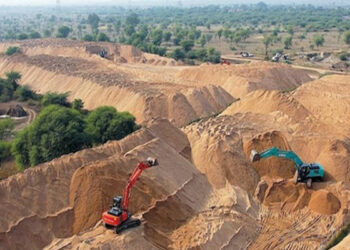
Union Finance Minister Nirmala Sitharaman made a historic announcement while presenting the Union Budget 2026-27 in Parliament on February 1, 2026. He said that the government will set up a rare earth corridor. This corridor will be developed specifically in four states where rare earth minerals are abundant: Odisha, Kerala, Andhra Pradesh and Tamil Nadu.
What did the central government say about rare earth minerals in the budget?
Finance Minister Nirmala Sitharaman clearly said in her budget speech, “We will now help mineral-rich states like Odisha, Kerala, Andhra Pradesh and Tamil Nadu to set up dedicated rare earth corridors. The aim is to promote mining, processing, research and manufacturing.” The move is based on the Rare Earth Permanent Magnet Scheme launched in November 2025, for which a provision of ₹7,280 crore was made. Budget 2026 further strengthens this scheme.
What are rare earth minerals and why are they so important?
Rare earth elements (REE) are a group of 17 minerals, including neodymium, dysprosium, and praseodymium. These are called ‘new generation oils’ because without them modern technology is difficult. They are used for a variety of purposes:
Electric vehicle (EV) batteries and motors.
Permanent magnets (used in high-speed motors).
Renewable energy (wind turbine, solar panels).
Smartphones, computers, high-tech gadgets.
Defense equipment (missiles, radar, jet engines).
Aerospace and clean energy technologies.
Refining these minerals is very complex, involving mining, crushing, separation, chemical processing and finally, high-purity refining.
What is China’s monopoly and India’s problem?
China is the world’s largest supplier of rare earth minerals. China controls approximately 60% of the world’s mining and more than 90% of the processing/refining of rare earth elements. 90% of permanent magnets are also produced in China. In recent years, China has repeatedly imposed restrictions or bans on exports, affecting global supply chains. India is also heavily dependent on China for these minerals, more than 45% of India’s rare earth imports come from China. This poses a threat to India’s EV, renewable energy, defense and high-tech industries. The objective of the announcement made in Budget 2026 is to end this dependence.
What will the Rare Earth Corridor do?
This will be a special network that will promote mining, set up processing plants, support research and development, promote manufacturing (especially of permanent magnets), and strengthen the supply chain by connecting these four states.
These states were chosen because they have large deposits of monazite (a major source of rare earth elements) in their beach sands. According to estimates:
Andhra Pradesh: 3.69 million tonnes
Odisha: 3.06 million tonnes
Tamil Nadu: 2.46 million tonnes
Kerala: 1.84 million tonnes
Overall, India has reserves of about 11 million tonnes. The budget has also removed 2.5% basic custom duty on the material used to make high-end permanent magnets from monazite. Relief in custom duty will be given on import of machinery and equipment required for rare earth processing. This will increase domestic production, reduce imports, and India will be able to become a global supplier.
What will be the benefits to India?
India can become a superpower by having control over rare earth minerals, because it will give it strategic advantage. India will become a global player in EVs, clean energy, AI, semiconductor and defense…
This will give new strength to the Self-reliant India initiative. The goals of Make in India initiative, EV mission and renewable energy will be achieved. Mining, processing, research and factories will create thousands and millions of jobs.
Industry experts (like CII) say that with this India can become a leader in rare earth magnets and critical minerals.
Defense and high-tech sectors will be strong.