New Delhi, February 11 (IANS). The space sector is growing rapidly in India. The government told Parliament on Wednesday that now more than 400 space startups are working in the country and more than $500 million has been invested in these startups.
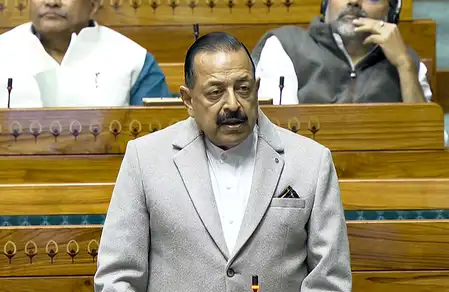
Minister of State for Science & Technology and Earth Sciences Dr Jitendra Singh said in a written reply in the Lok Sabha that two private sector companies have successfully launched and tested their rockets to sub-orbital (low orbit of space) in November 2022 and May 2024.
He said that till now 25 payloads have been sent or are going to be sent through PSLV Orbital Experimental Module (POEM). This platform gives private companies a chance to test their equipment in space. Additionally, six Indian Non-Government Entities (NGEs) have together launched 18 satellites into space.
The minister said that a group of Earth Observation satellites is being prepared under the Public-Private Partnership (PPP) model, which will encourage new experiments and increase confidence in Indian space companies in the world.
He further said that 25 companies are already testing their satellites and instruments in space using platforms like ‘POEM’. Many state governments are also considering the space sector as an emerging sector of the future and are making new policies and incentive schemes to promote companies.
After the announcement of ‘Startup India’ scheme, the number of startups in the space sector has increased rapidly. The scheme was launched by Prime Minister Narendra Modi on 16 January 2016 with the aim of promoting innovation, encouraging entrepreneurship and increasing employment opportunities in the country.
Several prominent space startups have emerged in the country since 2014, such as Pixel, Dhruva Space, Skyroot Aerospace, Agnikul Cosmos and Bellatrix Aerospace. Bengaluru-based company Pixel has launched its first commercial satellites named ‘Firefly’, which have the capability to take advanced images.
Similarly, Galaxy’s ‘Mission Drishti’ is going to be launched soon, which will be the world’s first multi-sensor Earth Observation Satellite. This will help India further strengthen its space surveillance capability.
–IANS
DBP/