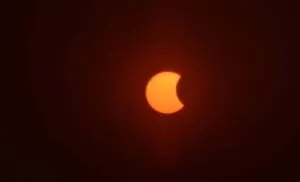
Lucknow: 17th February 2026 i.e. today the first solar eclipse of the year is taking place, which is of annular type. It is called the ‘Ring of Fire’ because the Moon covers the center of the Sun, but a bright ring is visible at the edges. This eclipse is falling in Aquarius and Dhanishtha constellation, due to which it is also being discussed from astrological point of view.
Eclipse time table as per Indian Time (IST):
– Onset (beginning of penumbral/partial phase): 3:26 pm.
– Maximum/peak phase (peak of the Ring of Fire): from 5:13 pm to 6:11 pm (maximum at approximately 12:13 UTC).
– End: 7:57 pm.
– Total Duration: Approximately 4 hours 31 minutes.
(These timings are global, but there will be no visible impact as the sun sets in India.)
Will ‘Ring of Fire’ be visible in India?
No, this solar eclipse will not be visible in any part of India. Main reasons:
– The path of the eclipse is mainly passing through Antarctica and some areas of the Southern Hemisphere (South Africa, southern parts of South America, parts of the Pacific/Atlantic/Indian Ocean).
– At this time in India the Sun will be below the horizon (after sunset), so no change will be visible in the sky.
– The eclipse will remain invisible in all major cities like Delhi, Noida, Lucknow, Jaipur, Mumbai, Kolkata, Chennai, Hyderabad. Therefore, there will be no direct impact of the eclipse in these cities.
Sutak period and religious rules:
Since the eclipse is not visible in India, the Sutak period (inauspicious period before the eclipse) will not be applicable. According to the scriptures, Sutak is valid only in those areas where the eclipse is visible. Therefore, people can do their daily work, worship, eat food etc. normally. There are no specific restrictions.
Where will this special eclipse be seen?
– Full annular phase (Ring of Fire): mainly at some stations in Antarctica (e.g. Concordia, Mirny), where the maximum will last 2 minutes 20 seconds.
– Partial eclipse: in southern parts of South Africa, Argentina, Chile.
– Enthusiasts around the world can watch it through live streams from NASA or other space agencies.
This eclipse is astronomically rare, but you will not get a chance to see it from India. The next visible eclipse may occur in India in the form of a lunar eclipse in March 2026.