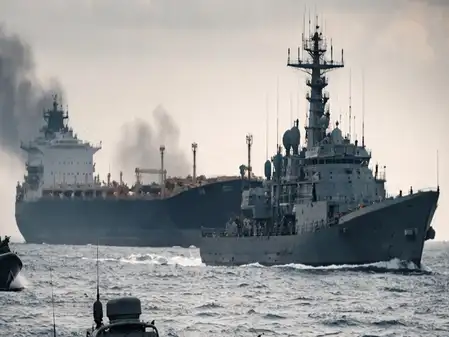
New Delhi/London, March 5 (IANS). Due to the increasing military conflict between Iran, America and Israel, there is a maritime threat in the Gulf of Oman, Persian Gulf and the Strait of Hormuz. The atmosphere has become very unstable in the last 24-48 hours.
Commercial ships have been targeted in numerous projectile, missile and explosive attacks, almost completely halting the passage of ships through this vital waterway.
Iran started retaliating after the US and Israel attacked Iranian targets in late February. After this, attacks on many merchant ships have been confirmed.
Reports indicate at least three to eight commercial ships (including oil tankers and one container ship) were damaged. These attacks included drone boats, missiles and close-range explosions. At least one sailor died and several others were injured.
The Strait of Hormuz through which about 20 percent of the world’s seaborne oil and liquefied natural gas transport occurs. Only a few ships have been seen here in recent days, which is much lower than normal.
Hundreds of ships, including oil tankers and liquefied natural gas carriers, are still stuck in the area’s waters or anchored in safe havens. Major shipping operators such as Maersk and Hapag-Lloyd have completely stopped transiting the Strait of Hormuz. Few ships are now routed via the Cape of Good Hope, significantly increasing travel time and costs.
Adding to the cyber threats, “persistent GPS and AIS jamming” is seriously impairing navigation safety.
“Continuous GPS and AIS jamming” is further complicating the situation. Maritime intelligence companies have recorded electronic interference on more than 1,100 ships in recent days, revealing the false locations of many ships.
Many war risk insurance providers have canceled their coverage in Iranian waters, the Persian Gulf and the surrounding area, making alternative measures expensive and difficult for shipowners.
The Joint Maritime Information Center (JMIC) has increased the threat level in the area to critical, indicating that attacks are almost certain.
The US MARAD advisory tells ships to avoid the area if possible, maintain a 30-nautical-mile separation from naval assets, and implement enhanced measures. Merchant vessels are advised to exercise heightened vigilance, maintain enhanced surveillance, cross-verify all navigation inputs (including radar and visual bearings), and strictly adhere to “Best Management Practice (BMP5 or MS)” security protocols while transiting or operating in this area.
–IANS
AY/DKP