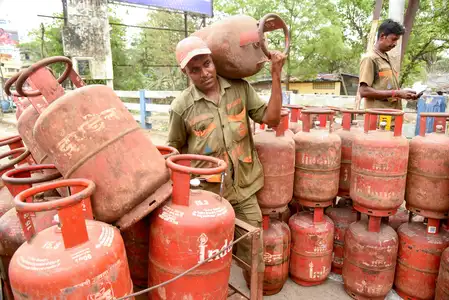
New Delhi, March 12 (IANS). The government has approved giving Rs 30,000 crore for LPG subsidy to public sector oil companies (PSUs) in the financial year 2025-26. This amount will be given to government oil companies like Indian Oil, Bharat Petroleum and Hindustan Petroleum so that they can provide domestic cooking gas (LPG) cylinders at concessional prices. This information was given in Parliament on Thursday.
The price of 14.2 kg domestic LPG cylinder in Delhi is currently Rs 913.
Minister of State for Petroleum and Natural Gas Suresh Gopi said in a written reply in the Lok Sabha that after giving a targeted subsidy of Rs 300 per cylinder to poor consumers under the Pradhan Mantri Ujjwala Yojana (PMUY), the central government is providing 14.2 kg LPG cylinders to the beneficiaries at an effective price of Rs 613 per cylinder (in Delhi).
To increase the availability of LPG in the domestic market, the Ministry has directed all domestic oil refineries and petrochemical complexes to use C3 and C4 gas streams for LPG production.
The minister said that this LPG production will be supplied only to public sector oil companies. These orders have been issued under the Essential Commodities Act.
Suresh Gopi also said that the government has created strategic crude oil reserves with a capacity of 5.33 million metric tonnes through a special company named Indian Strategic Petroleum Reserve Limited (ISPRL).
These reserves will help deal with disruptions in the supply chain in situations like the Iran war.
The minister said that the prices of petrol and diesel in the country are decided according to the market, and the public sector oil marketing companies decide on their prices.
However, when necessary, the government also takes financial intervention to reduce the burden on consumers by changing the tax structure.
He said that in November 2021 and May 2022, the Central Government had reduced the Central Excise Duty on petrol by Rs 13 per liter and on diesel by Rs 16 per liter in two phases, the full benefit of which was passed on to the consumers.
Apart from this, in March 2024, oil companies had reduced the retail prices of petrol and diesel by Rs 2 per liter.
However, when the excise duty on petrol and diesel was increased by Rs 2 per liter in April 2025, the burden was not passed on to the consumers.
–IANS
DBP