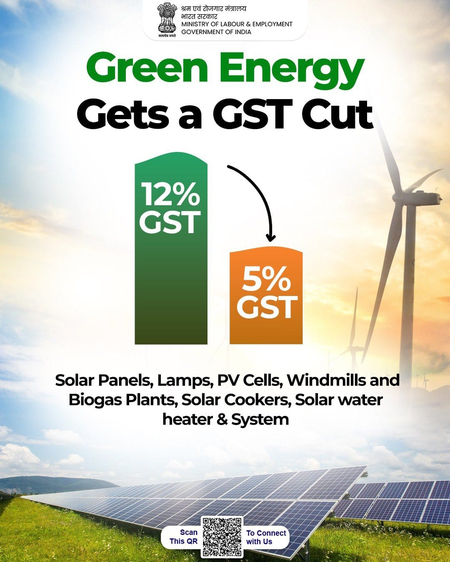
New Delhi, 16 September (IANS). According to information given by the central government on Tuesday, GST reform is an important step towards taking forward the climate goals of India by making renewable energy, waste management, biodegradable products and green mobility more economical and accessible. Cost reductions will accelerate adopting pollution control solutions by encouraging domestic manufacturing and supporting sustainable industries.
The GST rate on solar and wind equipment has been reduced from 12 percent to 5 percent. These devices include solar cooker, biogas plant, solar energy -based equipment, solar power generator, windmills, wind -powered electrical generators, vest to energy plant and devices, solar lanterns / solar lamps, Ocean Waves Energy devices and plant and photo voltage cells.
According to the Center, solar panels due to reduction in GST rate, P.V. Cell, wind turbines and capital costs of related equipment will directly decrease. This cut will increase the viability of solar and wind power projects, which will reduce tariffs for final consumers.
GST rate cuts will promote domestic manufacturing by supporting India’s solar cell and module manufacturing ecosystem under PLI schemes, making domestic products more competitive than imports. This will make the solar pumps more economical, reduced irrigation costs and will help farmers.
According to an official statement, the established capacity of solar energy in India has increased by more than 42 times, which has increased from 2.82 GW to 119.54 GW by July 31, 2025 in 2014.
India has continued the process of separating economic development from greenhouse gas emissions. Between 2005 and 2020, India’s GDP (GDP) emission intensity has decreased by 36 percent.
Similarly, the GST rate on waste treatment (CETP) under waste management and pollution control has been reduced from 12 percent to 5 percent. The GST rate has now been reduced to 5 percent on services provided by the Common Fluent Treatment Plant.
According to the government, tax cuts on CETP will inspire industries to use centralized waste treatment methods, resulting in a pollution -free environment and will promote sustainable development in industrial areas. This will help the municipal corporations to implement clean energy solutions for waste management. GST cuts will create green employment in areas such as waste separation, plant operation and maintenance.
The GST rate on biodegradable bags has also been reduced to 5 percent. They become more economical due to reduced GST on biodegradable bags, encouraging consumers and retailers to move away from single-use plastic and thus help reduce plastic pollution.
-IANS
SKT/