New Delhi, May 10 (IANS). This incident happened on May 11, 1998. American intelligence satellites were keeping a close eye on every nook and corner of India from the sky. It seemed impossible to dodge them. But, still, they were deceived. Suddenly the ground shook and seismographs around the world recorded a movement that changed the geopolitical history of India forever.
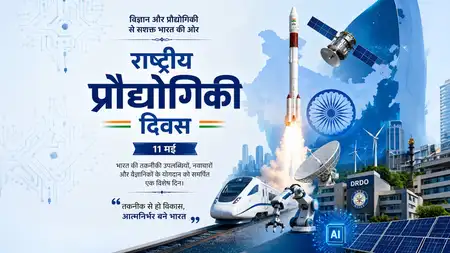
This was India’s successful underground nuclear test ‘Operation Shakti’. On the same day, our scientists surprised everyone by successfully flying the indigenous aircraft ‘Hansa-3’ in the sky and testing the accurate ‘Trishul’ missile. India had proved its mettle in nuclear, aviation and defense sectors in a single day. Saluting our indomitable scientific will, the then Prime Minister Atal Bihari Vajpayee declared May 11 as ‘National Technology Day’.
Today technology has become another name for ‘welfare’. Today, a farmer from a remote village is getting the exact price of his crop and accurate weather information on his phone through ‘e-Choupal’. Great initiatives like ‘STEM on Wheels’ have taken mobile clinics directly to the villages, where a poor patient is getting his treatment over video call from top doctors in the cities. Women working in Anganwadi are saving children from malnutrition with the app ‘Nutrition Tracker’. This is the real technological revolution of real India, where innovation is changing the ground reality.
If you want to know how the world views India today, then remember the ‘India AI Impact Summit’ held at Bharat Mandapam, New Delhi in February 2026. The heads of state of more than 15 countries and the crowd of more than 70 thousand people became witness to the fact that India no longer follows the world in terms of technology, but shows the way to the world.
All this is not magic. Behind this lies the years of penance of those anonymous scientists, researchers, young students and startups, who are writing the future of the country in closed rooms of the lab. The work of giving wings to these talents is done by the ‘Technology Development Board’ (TDB) of the Government of India.
Every year on this day, TDB awards ‘National Technology Award’ and ‘National Science Award’ to such startups and MSMEs, which have brought paper research into the real market. Be it a company making cheap indigenous vaccines like ‘Rotavac’ or edtech startups that are changing rural education.
The government is giving flight to the dreams of these innovators by providing them financial assistance worth crores of rupees. Along with this, from Delhi University to Sharda University, ‘Hackathons’ and ‘Robo Races’ are being organized for students everywhere, so that the minds of the new generation can be prepared for innovation.
Today when we look ahead to 2026, our eyes are set on deep-tech, quantum missions and building our own semiconductor hub. Today India is competing with the top countries of the world in filing patents.
May 11 reminds us of only one thing. In 1998, we made the world realize our power, and today in 2026, we are showing the world the path to a safe and inclusive future.
–IANS
VKU/ABM