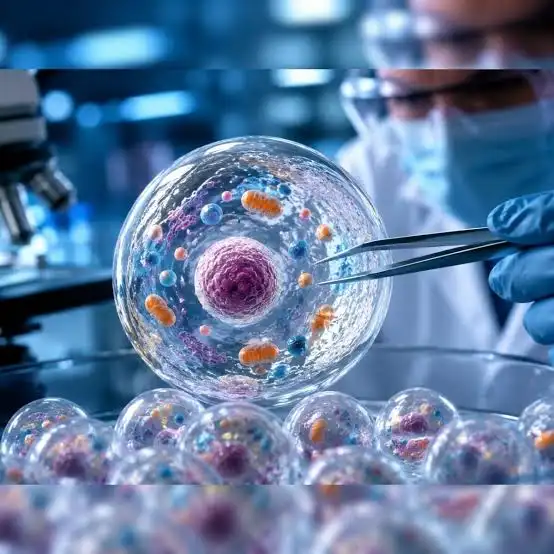
Scientists have claimed to have achieved a major success in the field of biology. Researchers have created artificial cells that can grow and replicate by absorbing nutrients just like natural cells. Scientists believe that this discovery can prove to be an important step towards creating life-like systems from inanimate things in the future. This project named “Spudcell” has been prepared by scientists from Minnesota University of America.
What are its main features?
According to Kate Adamala, the scientist who led this research, her team has used chemistry to successfully replicate processes that were previously thought to be characteristic only of living cells. He says that the basic properties of life – such as growth and replication – do not depend on some mysterious force, but can be scientifically modeled. However, he also made it clear that the spudsail cannot be considered a fully living organism.
In fact, these artificial cells are still lagging behind natural cells in many respects. They need external nutrients and ribosomes (which make proteins) to survive. Additionally, they lack the ability to protect themselves from infection and cannot eliminate waste products properly; Overall, they cannot survive independently for long.
Why is this discovery considered so important?
Experts consider this achievement very important because for the first time basic life-like processes have been successfully demonstrated in an artificial system. Scientists believe that further development of this technology will lead to the creation of specially designed microscopic living systems – or “living machines” – that could be used in fields such as medicine, environmental protection and biotechnology.
How is it different from natural cells?
Spudcells are designed to be much simpler than natural cells. Cells usually rely on an internal structure called a cytoskeleton to divide, but scientists took a different approach for “spudcells.” In this method, specific proteins accumulate on the cell membrane and apply enough pressure to tear the membrane in two. The researchers also made a genetic change that increased the production of a particular fusion protein. As a result, the cells grew faster than before and started making more new cells.
**Important for biological research**
The scientists observed that after five generations, the faster-growing cells were better than the original cells. Another special thing is that the human genome is about 3 million kilobase pairs, whereas the size of the spudcell genome is only 90 kilobase pairs. Its genetic material is divided into seven separate DNA plasmids rather than one large chromosome, allowing scientists to independently control and program the cells’ various functions. This quality makes this technology very important for future biological research.