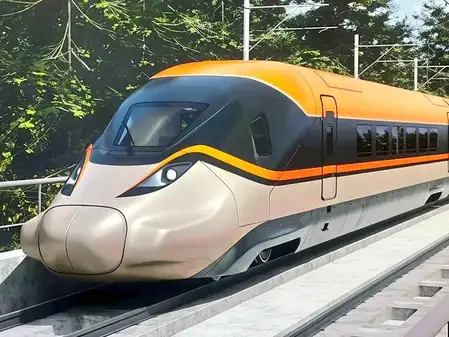
New Delhi, July 3 (IANS). The Mumbai-Ahmedabad High-Speed Rail (MAHSR) project, India’s first bullet train corridor, is now reaching its final stages. The government on Friday said that this project will serve as a standardized model (standard template) for all future bullet train corridors to be built in the country.
After the completion of the Mumbai-Ahmedabad High-Speed Rail Project, the travel time between Mumbai and Ahmedabad will reduce to about 1 hour 58 minutes. The design speed of this corridor is 350 kilometers per hour, while the operating speed of trains will be 320 kilometers per hour. For this, state-of-the-art rolling stock, signaling and train control systems will be used.
12 stations are proposed in this corridor of about 508 kilometers long. The first bullet train service under the project is expected to start in August 2027. In the initial phase the train will be operated between Surat and Vapi.
The government says the Mumbai-Ahmedabad High-Speed Rail Project is not just a transportation project, but it is also creating the necessary technical knowledge, skills and industrial ecosystem for expanding the high-speed rail network across the country in the future.
According to the official statement, the project is establishing a scalable model for the future high-speed rail corridors, which will provide better connectivity in the upcoming projects, reduce travel time and also accelerate the long-term economic growth of the country.
The government has identified seven high-speed rail corridors of about 4,000 kilometers long for the future. There is a possibility of investment of about Rs 16 lakh crore in these projects.
Based on the experience of Mumbai-Ahmedabad project, a similar engineering design, construction techniques and operation system will be adopted in future projects, which will help in faster completion of projects and also improve the quality of construction.
The government said the availability of spare parts, staff training and procurement processes would also be simplified due to uniform design, equipment and maintenance procedures. However, the foundation will be designed according to the nature of soil of each location, while all other major structures will conform to the same engineering standards.
These standards will include pillars, viaducts, tracks, station structures, overhead electrification and signaling systems. The government believes that this standardized system will speed up the construction of future high-speed rail corridors, improve quality and also reduce the cost of projects.
–IANS
DBP