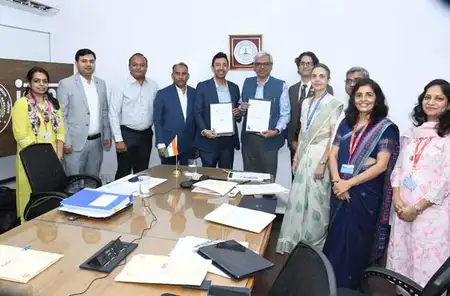
New Delhi, July 21 (IANS). The Indian Council of Medical Research (ICMR) has granted licenses to the country’s leading drug and vaccine manufacturing companies for the development, manufacturing and commercialization of three indigenous biomedical technologies. This information has been given in an official statement.
The Ministry of Health and Family Welfare said in a statement that the transfer of these technologies is a major step towards converting government-funded research into affordable health services. This will also strengthen India’s biomedical innovation system.
‘Shata-2’ is also included in these technologies. It is a new anti-human papilloma virus (HPV) drug developed for the treatment of cervical pre-cancerous conditions (CIN). The license for its development and manufacturing has been given to Emcure Pharmaceuticals Limited.
Two next generation vaccine technologies against enteric bacterial infections developed at ICMR-National Institute of Research in Bacterial Infections (ICMR-NIRBI), Kolkata were also licensed to Biological E Limited.
SHETA-2 has been developed by Dr. Shaukat Hussain of the Indian Council of Medical Research-National Institute of Cancer Prevention and Research (ICMR-NICPR) in collaboration with Dr. Doris M. Benbrook of the Stephenson Cancer Center, University of Oklahoma, USA.
It is the first targeted treatment drug of its kind, which selectively destroys cervical pre-cancerous and cancerous cells caused by human papilloma virus (HPV) without harming healthy cells.
The statement said that this technology can become a safe, economical and less surgical treatment option for cervical cancer.
The vaccine technologies the team has developed also include a fusion technology. It contains the outer membrane protein of the bacterium Salmonella Typhi. This is a potential next generation vaccine to prevent typhoid.
It also includes a recombinant vaccine against infections caused by Salmonella typhi, Salmonella paratyphi, and Shigella. It is designed to provide comprehensive protection against major bacteria that cause intestinal infections.
The statement said that all these technologies will strengthen India’s efforts to prevent cancer and control infectious diseases. Besides, it will also promote the development of next generation indigenous medicines and vaccines.
The statement said that ICMR has created an integrated innovation mechanism (innovation ecosystem), which helps in the entire process of development of health technologies. This includes the entire process from new discovery, intellectual property protection, clinical trials, regulatory support and commercial exploitation.
–IANS
SHK/PM