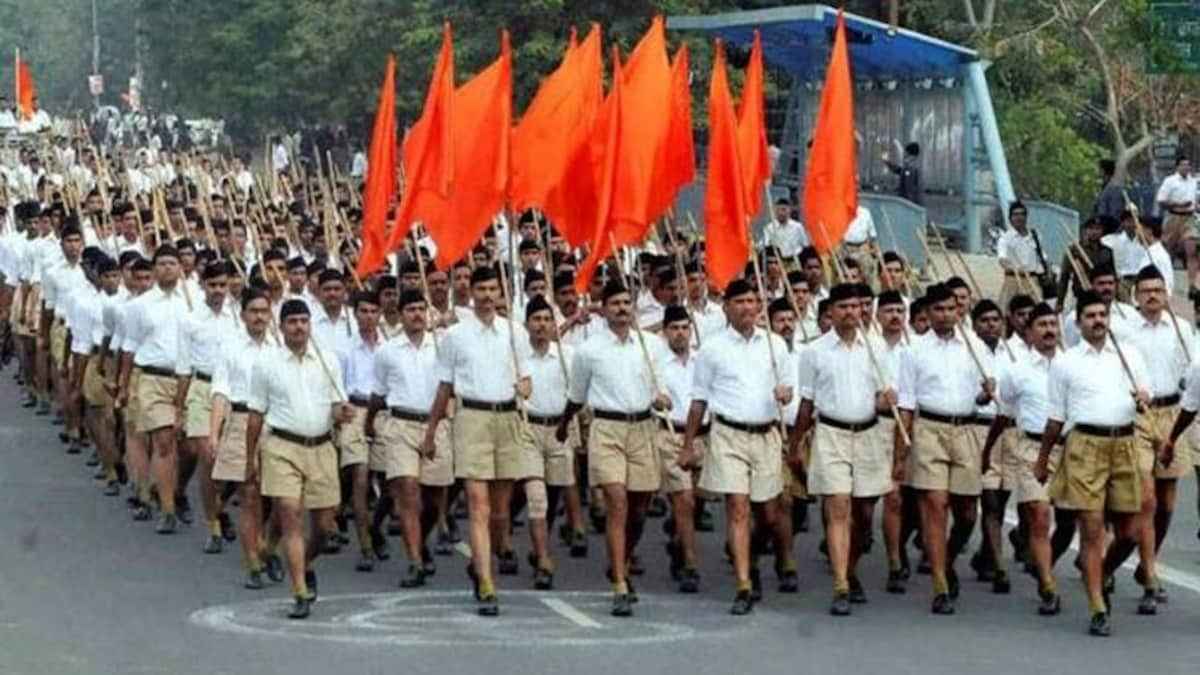
Today, 100 years of establishment of Rashtriya Swayamsevak Sangh were completed. To unite Hindu society and build people’s character, has been in major values of RSS. The Sangh received the outlook of different Sarsanghchalars at different times, who came from diverse areas. He has left an indelible mark on the organization with his working style.
In 1925, on the occasion of Dussehra (27 September) in Nagpur, the Rashtriya Swayamsevak Sangh (RSS) was started by a branch by Keshav Baliram Hedgewar, a doctor from Maharashtra. According to journalist Sudhir Pathak, in the last 100 years, each of the six Sarsanghchalars or heads of the Rashtriya Swayamsevak Sangh made changes to the organization’s attitude in dealing with many issues and tried to maintain coordination with the changing times.
Although Hedgewar established the RSS in 1925, his name as Sarsanghchalak was announced on 10 November 1929 after four years. Hedgewar was also an official of the Congress in the past, but he attended a party conference held in Nagpur in 1920 before setting his independent path. Subsequently, in 1930, he was put in jail due to participating in ‘Jungle Satyagraha’ and when Hedgewar was in jail, Dr. LV. Paranjpe was Sarsanghchalak for some time.
Significantly, Hedgewar, along with 17 others, established the RSS. It started with its residence ‘Hedgewar Wada’ located in New Shukrawari area in Mahal, Nagpur. The formal name of the organization was decided in a meeting of 26 members a few months later. Rashtriya Swayamsevak Sangh, Jaripatka Mandal and Bharatdarak Mandal – these were the three names that were finalized.
Later, the name RSS got 20 votes, Jaripatka Mandal got 5 and Bharatdarak Mandal got 1 vote. Similarly, the organization was named Rashtriya Swayamsevak Sangh. The former editor of the RSS newspaper ‘Tarun Bharat’, while talking to PTI-language, said that the early branches were held in the ground in front of the Itwar Darwaza School in Nagpur. As the number of volunteers increased, these branches began to be installed in ‘Mohite Wada’ in Nagpur.
For the first time on 18 February 1926, the branch started in Wardha outside Nagpur. Till date, RSS has more than 83,000 branches with millions of volunteers. This basic unit of the Rashtriya Swayamsevak Sangh consists of volunteers to participate in activities like community service and physical exercise.
Let us know that Hedgewar attended his last meeting of RSS in Sindi in Wardha district in 1939, which was an officer training camp (OTC), in which three important decisions were taken regarding the organization.
Pathak said that first, the RSS prayer – ‘Namaste Sada Vatsale Matrubhumay’ – which had only two verses earlier, was converted into a whole new prayer written by a school teacher NN Bhide. Second, it was decided to create a new uniform for volunteers. Third, it was decided that the orders of the RSS would be issued in Sanskrit instead of English.
Hedgewar died on 21 June 1940, but before his death he appointed Madhavrao Sadashiv Golwalkar (34), who was known as ‘Guruji’, as the new Sarsanghchalak. Golwalkar played an important role in shaping the RSS for the next three decades and recovering it with the shaking of the first ban on the organization.
Although Golwalkar died in 1973, he wrote four letters before that. In one of these, he announced the name of his successor Balasaheb Deoras, who led the Sangh during the Emergency (1975–77). Emergency was the first major challenge before Deoras, when all branches were closed and they were arrested and sent to Yerwada Central Jail of Poona (now Pune).
According to the reader, when the Emergency was removed and the Deoras came out of jail, he adopted the outlook of ‘forget and forgive’. Deoras had said, “We should forget and forgive the policy of forgiveness. Emergency should not have been imposed, but this does not mean that we will be against him.”
He established himself as a social reformer and strongly opposed caste discrimination and untouchability. He famous announced, “If untouchability is not wrong, nothing is wrong in the world,” and further said, “We are all one and Hindus.”
Pathak mentioned that Deoras joined backward classes and deprived people to broaden the basis and influence of the RSS.
Pathak said that the sick Deoras broke the decades -old tradition and announced that Professor Rajendra Singh, known as Rajju Bhaiya, would be successful. This was the first time in the history of RSS that Sarsanghchalak announced a heir to survive.
Pathak said that Sarsanghchalak was a Sarsanghchalak, an astronomer physicist and professor at Allahabad University from 1994 to 2000. He was the first non-Maharashtra RSS chief. In his place, electronics engineer K.S. Sudarshan was appointed. Under the leadership of Sudarshan, more and more sections of the society joined the RSS. Pathak told that Sudarshan reached Muslims, interacted with them and invited them to the RSS headquarters. He said that he also interacted with Christians.
The current Sarsanghchalak Mohan Bhagwat, who is seen as modernization, expanded the RSS and held a lecture series in Delhi, inviting people from all areas.
Last month, on Bhagwat’s 75th birthday, Prime Minister Narendra Modi praised him for his intellectual depth and sympathetic leadership and announced that his tenure as RSS chief since 2009 would be considered as the most transformative period in the organization’s 100 -year journey.