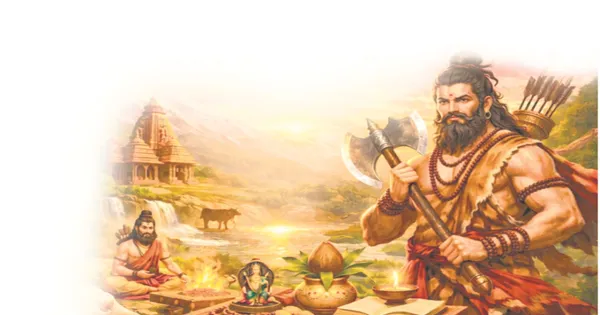
Gaurishankar Vaishya Humble / Lord Parashuram’s place in the Indian Sanatan tradition is very special. He is considered to be the sixth incarnation of Lord Vishnu and the only such Chiranjeevi. Lord Parashuram has been mentioned in many texts like Ramayana, Mahabharata, Bhagwat Purana and Kalki Purana. His personality is a symbol of tenacity, bravery, justice and social balance. His life is not just a war story, but an inspiring history of struggle against injustice, establishment of dignity and restoration of religion. It is said that most of the villages of India were settled by them. He was one of the most obedient children of Bhargava Gotra. He always followed the orders of his teachers and parents.
Lord Parshuram was born to Maharishi Jamdagni and Mother Renuka. His name was ‘Ram’, but because he held a Parshu (axe) in his hand, he was called ‘Parshuram’. His birth is considered to be on Tritiya (Akshaya Tritiya) of Shukla Paksha of Vaishakh month as per Hindu calendar in Tretayuga (which is on 19 April this year). Since childhood, he was blessed with extraordinary talent, strict discipline and amazing brilliance. He received knowledge of divine weapons and warfare from Guru Dattatreya and Mahadev Shiva. The divine Parshu received from Shiva became the main symbol of his life.
There is an example in Shrimad Bhagwat that seeing Gandharva king Chitrarath walking with Apsaras, Renuka, who had gone to collect water for the havan, became enamored and stayed there for some time. After the havan period had passed, sage Jamadagri, enraged, ordered his sons to kill Mother Renuka as a punishment for his wife’s anti-Aryan conduct. When all the other brothers could not muster such courage, the devoted Parashuram killed his mother as per his orders. He also killed all his brothers who came to save him.
Pleased with his work, his father Jamdagni asked him to ask for a groom. So Parashurama asked for the boon of everyone being resurrected and the memory of their killing being destroyed. The era of Parashurama was a time when some kings of the Kshatriya class, in the name of power, glory and power, became inclined towards injustice, oppression and injustice. Abuse of state power started increasing. A particularly notable example from history is King Kartavirya Arjuna (Sahasrarjuna), who tortured and ultimately murdered Maharishi Jamadagni in his ashram. This incident proved to be a turning point in Parashuram’s life.
Distressed by the murder of his father, Parashurama took a vow that he would eradicate the unrighteous Kshatriyas from the earth. He fulfilled his resolve to make the earth devoid of Kshatriyas twenty-one times. This statement symbolizes not only bloodshed, but also a warning against misuse of power and restoration of social balance. He performed Ashwamedha Mahayagya and donated the earth containing Saptadweep to Maharishi Kashyap. not merely. He gave up his weapons before Devraj Indra and got absorbed in penance by building an ashram on Mahendra Mountain, the land left by the ocean.
The bravery of Lord Parshuram was unique. His bravery was not limited to muscle power only, but it also included moral courage and sense of justice. Parashuram proved that the use of power is meaningful only when it is for the protection of religion. Even in the Mahabharata period, the influence of Parashurama is clearly visible. He was the teacher of great warriors like Bhishma Pitamah, Dronacharya and Karna. His battle with Bhishma is a reflection of Parashurama’s indomitable bravery. Although this war is not seen for anyone’s defeat, but as a test of the Guru-disciple and the prestige of the religion.
Parashurama was not only a warrior but also a great ascetic and social reformer. He made both the Brahmin and Kshatriya classes aware of their duties. The message that comes from his life is that a person’s identity is determined not by birth but by actions. The story of creation of the land of Kerala is also related to Parashurama. It is believed that he created a new land by retreating the sea and established religion, education and culture there. For this reason, even today in Kerala, Parashurama is remembered with reverence as the ‘Father of the Land’. The life of Lord Parshuram is extremely relevant even in today’s era. They teach that standing against injustice is the true religion. At the same time, his ascetic nature also shows that restraint and self-control are essential along with power.
Parashurama’s personality establishes the balance that when dialogue and peace fail, then bravery becomes necessary to protect the religion, but after victory, renunciation and penance are the best path. Lord Parashuram is a unique ideal of religion, bravery and penance in Indian culture. He is such a warrior-saint, whose life represents a combination of both struggle against injustice and spiritual upliftment. Their history inspires us that courage, morality and self-control all three have equal importance to maintain balance in the society. Parashuram is not just a mythological character but a living ideal who provides guidance for ages.