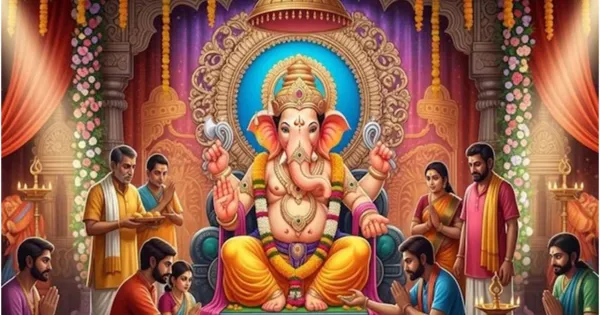
Fasts and festivals have unique importance in Indian Sanatan culture. One of these holy fasts is ‘Tilkuti Vrat’ or ‘Sakat Chauth’, which is dedicated to Lord Ganesha. This fast is celebrated with special rituals on the Krishna Paksha Chaturthi date of Magh month. Mothers observe this fast for the longevity, happiness, prosperity and all-round well-being of their children. Worship of Lord Ganesha, the remover of obstacles, solves all problems and brings auspiciousness in life. Tilakuti Vrat is known by different names like Sakat Chauth, Sankashti Chaturthi, Til Chaturthi and Maghi Chaturthi. The word Sankashti means one who overcomes troubles. -Jaidev Rathi Bharana
Lord Ganesha is worshiped as the God who removes troubles, hence this fast is called Sankashti Chaturthi. The name ‘Tilkuti’ came about because on this day, items made from sesame seeds and jaggery, especially Tilakutta or sesame laddus, are offered to Lord Ganesha. Modak and laddus are very dear to Lord Ganesha and sesame laddus are the main offering of this fast. The fast begins with the worship of Lord Ganesha.
According to the legend, once the gods were surrounded by many troubles. He went to Lord Shiva seeking help. At that time Karthikeya and Ganesh ji were also present there. Lord Shiva asked who could relieve the sufferings of the gods. Both the sons declared themselves capable. While taking the test, Lord Shiva said that the one who will come first after circling the earth will help the gods.
Kartikeya immediately set out on his peacock, but Ganesha thought that it would take a lot of time to circumnavigate the entire earth on his vehicle, the rat. Then wise Ganeshji circumambulated his parents Lord Shiva and Mother Parvati and said that the entire universe is contained in the parents. Pleased with this, Lord Shiva declared Ganesha victorious and blessed that whoever worships Ganesha with devotion on the day of Chaturthi and offers Arghya to the moon at night, all three heats – physical, divine and physical – will go away.
There was a moneylender and a moneylender, who did not believe in religion and virtue. Because of this they did not get the happiness of having a child. One day the neighbor was listening to the story of Sakat Chauth. When the moneylender asked what it was, the neighbor told that this fast brings food, wealth, marriage and children. The moneylender took a vow that if she got pregnant, she would wear 1.25 seer of Tilkut. His wish was fulfilled. Then she took a pledge of two and a half pounds of Tilkut to have a son and she got a son, but when prosperity came, the moneylender forgot her vow and resolution.
As a result, Chauth Mata became angry and put her son in trouble. When the moneylender realized his mistake, he made two and a half maunds worth of Tilkut and observed the fast of Sakat Chauth as per the rituals. Ganesh ji and Chauth Mata were pleased and returned their son home safely. Sesame seeds have special significance in the month of Magh. Bathing with sesame seeds, offering food, donating food and drinking water mixed with sesame seeds – these Shattil Karmas destroy the sins.
In the month of Magh, one who donates sesame seeds, eats food with sesame oil and performs havan with sesame seeds attains the ultimate goal. The medicinal properties of sesame are amazing – it generates heat in the body, is an excellent source of calcium, iron, magnesium, increases immunity, strengthens bones and teeth and is beneficial for skin and hair. Jaggery is also an instant source of energy and helpful in blood purification. The combination of sesame and jaggery serves as a complete diet in winter. This is proof of the scientific thinking of our ancestors.
Mothers observe this fast for the longevity, happiness, prosperity and healthy life of their children. This fast is a symbol of unity and love in the family. It is believed that opening the Tilakut by the son and distributing it among the brothers increases the feeling of mutual love. In some areas, a Tilkut goat is made whose neck is cut by a small child of the house. In Bihar and Jharkhand it is called Tilkut Chauth, Sakat Chauth in Uttar Pradesh, Sankashti Chaturthi in Rajasthan and Til Gud Ghya Aani God God Bola (Take sesame and jaggery and speak sweet) in Maharashtra.
There is a special description of Tilkuti in folk songs. In the folk tradition of Bihar it is sung: ‘Magh Maase Ke Chauthi, Karihain Tilkut Ke Puja, Ganesha Ke Manibai, Bitwa Ke Rakkhaibai’ (On the Chauth of Magh month, will worship Tilkut, will celebrate Ganesha, will protect the son). In today’s busy life, when families are falling apart, festivals like Tilakuti bind the families together. This fast gives us many lessons.