
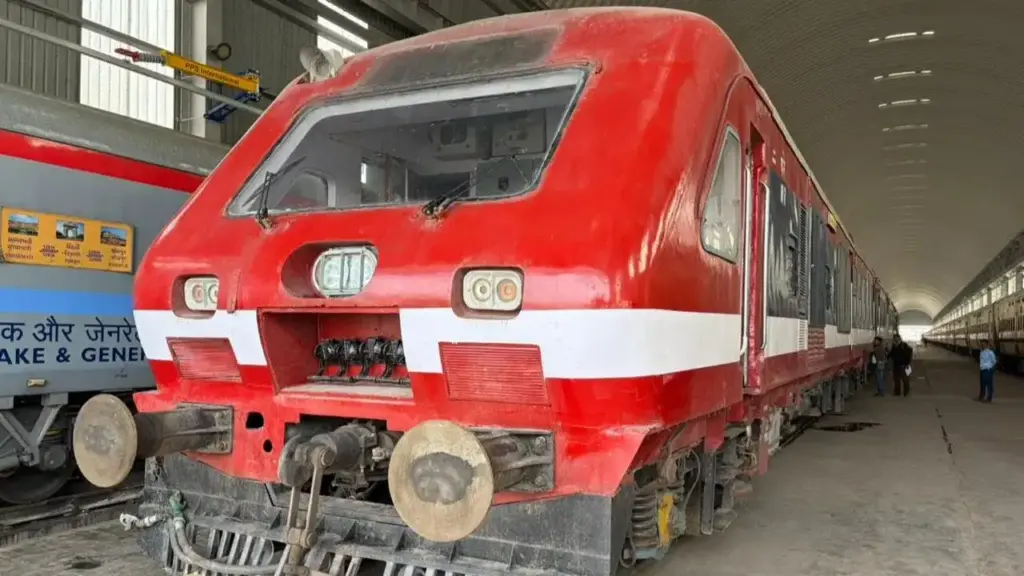
Indian Railways has achieved a historic achievement towards clean, environment-friendly and cost-effective rail operations. Ahmedabad Division of Western Railway has successfully adopted Liquefied Natural Gas (LNG) based dual fuel system in the Driving Power Car (DPC) of Diesel Electric Multiple Unit (DEMU) for the first time in the country. As a result, the country’s first LNG-powered DEMU train is now all set for regular operation.
As part of this important initiative, two DEMU DPCs of 1400 HP capacity have been converted to Diesel + LNG dual fuel system, thereby replacing approximately 40 percent diesel with LNG. These modified DPCs have successfully completed field trials of more than 2000 km, and are currently running in regular passenger service without any technical glitches.
Green Railway Mission
Meanwhile, Ahmedabad Divisional Railway Manager (DRM) Shri Ved Prakash inspected the DEMU shed at Sabarmati to review the preparedness, safety standards and maintenance arrangements related to the LNG-based system. The DRM took details from the officials and technical staff and described this innovation as a “game changer” for Indian Railways, calling it a major step towards the Green Railway mission.
Advantages of LNG dual fuel system
The use of LNG will significantly reduce engine emissions, especially carbon dioxide (CO₂), nitrogen oxides (NOx), and particulate matter (PM), which will improve the air quality around railway tracks. LNG is a cheaper fuel than diesel. According to test data, there can be savings of around ₹11.9 lakh every year for one DPC and around ₹23.9 lakh every year for an 8-coach DEMU rake (2 DPCs).
2200 liter capacity
The dual fuel engine can easily switch between diesel and LNG depending on fuel availability, without any interruption in operation. The dual fuel system is designed to maintain engine power and reliability compared to conventional diesel engines. As per the approved design, each DPC is fitted with a tank of approximately 2200 liters capacity (approximately 950-1000 kg of usable LNG).
Once fully filled, enough LNG is available for approximately 222 km of daily operation. According to railway sources, this technology will be scaled up on a large scale after emission testing and final approval from RDSO. In the next phase, eight more DEMU DPCs are planned to be converted to LNG dual fuel system, further strengthening Indian Railways’ commitment towards clean energy, low carbon emissions and cost-effective operations.