
Just hours after the ceasefire was announced between the US and Iran, the situation once again deteriorated as reports of attacks from both sides started emerging. Following this ceasefire violation, Iran blocked the movement of ships in the strategically important ‘Strait of Hormuz’, further increasing concerns about the possible impact on global energy supplies.
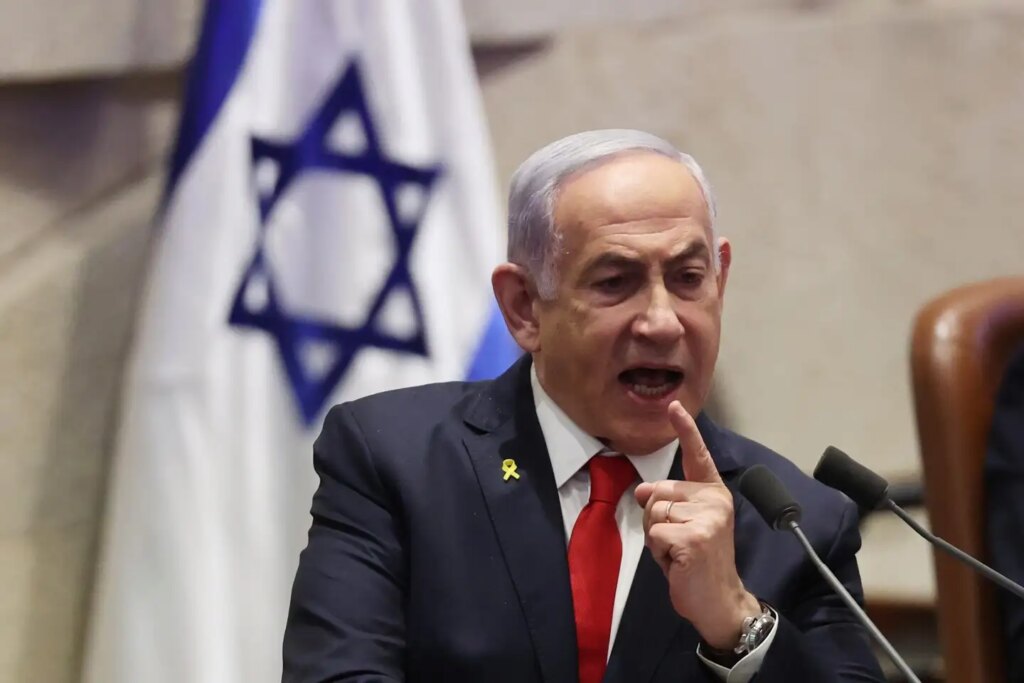
Meanwhile, Israeli Prime Minister Benjamin Netanyahu clearly stated that Israel’s “mission is still incomplete” and if necessary, conflict could be resumed. He said that although he and US President Donald Trump had agreed on a ceasefire, some objectives still remained—objectives that would be achieved either through negotiations or through military force.
Netanyahu’s announcement: the mission is still incomplete
Netanyahu also claimed that Israel has largely destroyed Iran’s missile production capabilities, and that the attacks now being conducted are being carried out using existing stockpiles. He further said that Iran’s stockpile of enriched uranium must be removed—whether through diplomatic agreement or the use of force.
The Israeli Prime Minister made it clear that Israel’s military operations will continue. He said attacks on Hezbollah strongholds in Lebanon would continue, as these actions were outside the scope of any agreement reached with Tehran. Netanyahu’s statement makes it clear that, despite the ceasefire with Iran, Israel is in no mood to relax its security posture—a stance that very much risks escalating regional tensions.
On the other hand, taking a tough stance, Iran has issued a warning: If Israel’s attacks on Lebanon are not stopped immediately, there will be a forceful retaliation across the region. Iranian President Massoud Pezeshkian also discussed the matter with Shehbaz Sharif and strongly condemned the ceasefire violations. Additionally, during a telephone conversation with the Prime Minister of Japan, the Iranian President expressed his distrust of the United States, saying that it has “a long history of deception”, making it difficult to trust it in any way. Iran’s response: “The agreement will be responded to with retaliation”
Despite the ceasefire, the continued war of words, attacks and counter-attacks indicate that the situation still remains extremely volatile and that the conflict could escalate into a full-scale war at any moment. The special thing is that on Wednesday morning a two-week ceasefire was announced between America and Iran, which gave hope that peace will be restored in the Middle East and the region will move towards ending the conflict.
However, within mere hours, reports of mutual attacks dealt a blow to these hopes, and it appeared that the ceasefire had failed to take effect. The situation worsened when Iran stopped an oil tanker in the strategically important ‘Strait of Hormuz’. Additionally, Iran has warned that if Israeli attacks against Lebanon continue without interruption, Tehran may also decide to break the ceasefire. This entire unfolding situation has made it abundantly clear that the path to peace is currently full of difficulties, and the Middle East is once again on the brink of a major conflict.