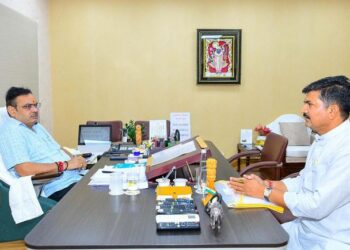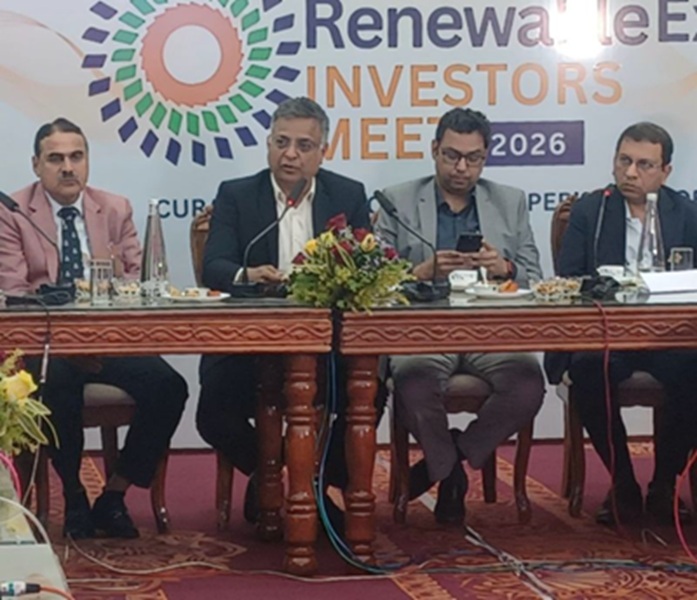
Jaipur. Ajitabh Sharma, Additional Secretary, Department of Energy, has said that in the coming years, State Power Utilities will not depend on generation-based bidding based only on minimum tariff for power purchase. Procurement strategy in the energy sector is now increasingly focused on system-level requirements rather than project-level.
He expressed these views during the CEO Roundtable of India Renewable Expo & Investors Meet 2026 held in Jaipur, in which some new aspects were also added. He said power procurement in the next 5–6 years will be done keeping in mind the medium and long term needs, with aspects such as reliability, flexibility and timely supply given priority. State power utilities will now look not just at price but also at what value a project is actually providing to the power system. Ajitabh Sharma said that recent experience shows that some arrangements, including some FDRE frameworks, may appear attractive initially, but in the medium to long term they may prove to be unsuitable or loss-making. This situation is particularly evident when such projects are evaluated at the system-wide level rather than at the project level.
He said there will be more stringent regulatory oversight over capital expenditure (Capex) planning and cost sharing, especially in cases where the cost of projects is passed on to consumers who are not actual or meaningful users of the system. There will be more questions and opposition to the socialization of CAPEX and OPEX among consumers in areas related to transmission and grid stability.
The Additional Secretary said that the principle of “User Pays, and Doer Bears” would be more relevant in apportioning CAPEX and OPEX. In the future, capacity-centric contracts may be replaced by service-oriented procurement, in which the role of demand-supply markets will increase in system balancing.
Additionally, demand flexibility, demand response and demand-side management will gain greater importance as cost-effective measures for grid management.
Ajitabh Sharma said that the overall procurement landscape in the energy sector is changing rapidly and the renewable energy industry needs to offer solutions that create system value rather than just returns to investors. The industry which moves beyond the mere appearance of tariffs in time and aligns itself with the system value, will be in a better position in the next phase of the energy sector.
Read this also – Click to read the news of your state/city before the newspaper.