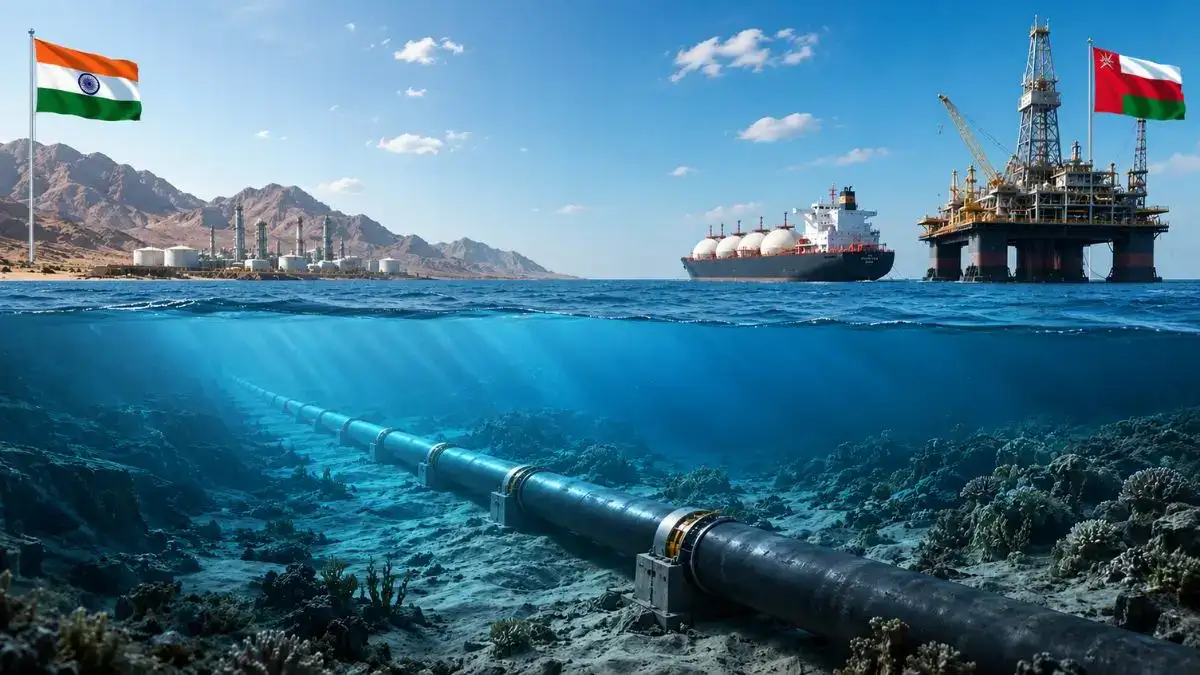
Amid tensions in West Asia, the energy crisis has worried the world – especially countries like India, which have been hit hard by supply disruptions from the Middle East. As a result, India is working quickly to ensure uninterrupted energy supply. India has announced plans to lay a long-distance pipeline connecting Oman to Gujarat.
This will be an approximately 2,000 km long deep sea gas pipeline in the Arabian Sea. The plan to link Oman and Gujarat has been under discussion for a long time, as India seeks to secure a more reliable supply of energy amid volatile geopolitical tensions.
Although the project has been reviewed several times over the past three decades, it has not progressed due to cost overruns, technical constraints and commercial challenges. Now, the project has gained new momentum as SAGE (a private group that supported the proposal) has completed a technical and financial study as well as a survey of the seabed to assess the route and engineering challenges.
**How much would it cost?**
The estimated cost of this project is approximately ₹40,000 crore. The Oman-Gujarat deep-sea gas pipeline will pass through one of the deepest sea routes ever built. This will make uninterrupted supply of natural gas easier. If built, the pipeline could create a direct energy corridor between the Gulf countries and India, reducing the country’s dependence on sea routes passing through the Strait of Hormuz.
**Why is this project important?**
India is heavily dependent on imported energy. The country imports most of its crude oil needs and is heavily dependent on foreign supplies of natural gas, especially LNG. A large part of these imports come from the Gulf countries and reach India through the Strait of Hormuz – a narrow passage that connects the Persian Gulf to the Arabian Sea. Any disruption in this route could have an immediate impact on global markets, affecting shipping costs, fuel prices and supply chains.
What will this pipeline look like?
The proposed project will directly connect Oman to Gujarat through an underwater network spanning the Arabian Sea. The most striking thing about it is its depth; Parts of the route are expected to be more than 3,000 meters below sea level, making it one of the deepest subsea pipeline projects ever proposed. This depth is much greater than most offshore energy projects and will require very specific engineering solutions. How much will transportation of gas cost?
Natural gas is expected to be supplied from this pipeline under a long-term supply agreement. This can help India diversify its energy sources and give Oman a stable market for exports. According to project proposals, transportation costs could range between $2 to $2.25 per MMBtu. However, the final cost will depend on funding arrangements, cost of construction and future gas prices.